


Seeing an ultrasound report mention “endometrial thickness 6 mm” or “uterus lining 8 mm” can quickly become stressful when you are trying to conceive. Many women immediately assume a thinner lining means pregnancy is impossible, especially during IVF or fertility treatment cycles.
In reality, endometrial thickness is only one piece of the fertility picture. Doctors look at the uterine lining together with ovulation timing, hormone levels, embryo quality, blood flow, age, and overall reproductive health before deciding what the measurement actually means.
- Check The Timing – Endometrial thickness changes through the cycle: 1 to 4 mm during periods, 5 to 7 mm before ovulation, 7 to 14 mm around ovulation, and 8 to 16 mm after ovulation.
- Aim For 7 mm – Around ovulation or embryo transfer, doctors generally prefer a lining of at least 7 mm, but pregnancy can still happen with a thinner lining.
- Look Beyond Thickness – Embryo quality, ovulation timing, hormone support, egg quality, age, uterine health, and blood flow also affect implantation and pregnancy.
- Find The Cause – Persistent thin lining, repeated IVF failure, recurrent miscarriage, or abnormal bleeding can lead to hormone tests, repeat ultrasound, hysteroscopy, or checks for uterine adhesions and polyps.
- Treat The Underlying Problem – Treatment can include estrogen, progesterone, hysteroscopy for scar tissue, and management of conditions such as PCOS, thyroid problems, insulin resistance, or hormonal imbalance.
What is endometrial thickness?
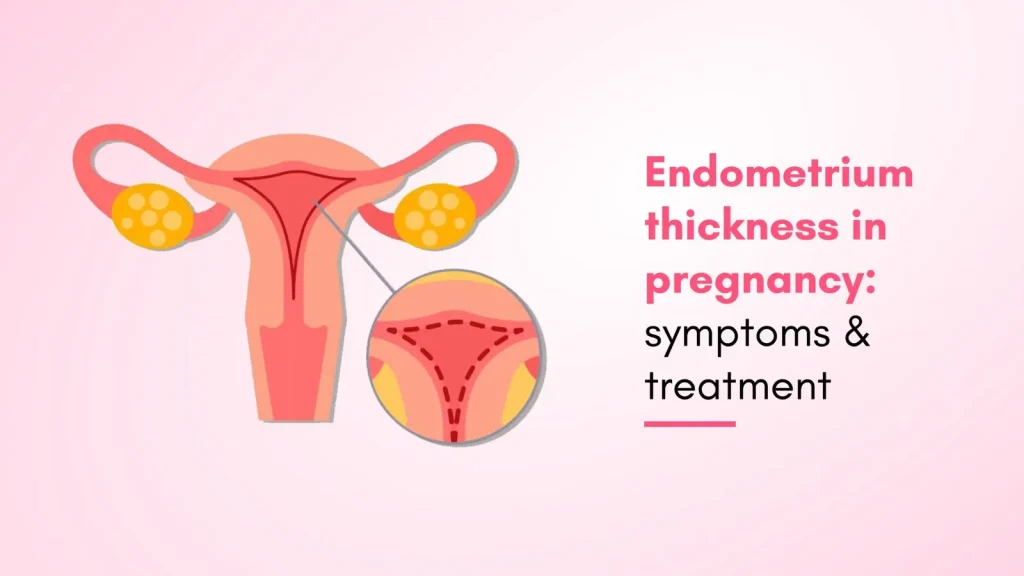
The endometrium is the inner lining of the uterus. This lining thickens every month in preparation for a possible pregnancy and sheds during menstruation if implantation does not occur.
Doctors usually measure the lining through transvaginal ultrasound. The report often lists the endometrial thickness in millimeters (mm), which is why many patients search for terms like “normal endometrial thickness in mm” or “endometrium normal size.”
One of the most common misconceptions is that there is one perfect number required for pregnancy. Fertility does not work that way. A healthy pregnancy depends on several interacting factors, not only the size of the endometrium.
What is the normal endometrial thickness for pregnancy?
In most fertility and IVF settings, doctors generally prefer the uterus lining thickness for pregnancy to be at least 7 mm around ovulation or embryo transfer.
Research suggests implantation rates may improve once the lining reaches approximately 7 to 8 mm during assisted reproductive cycles (Source: American Society for Reproductive Medicine).
Still, pregnancies can occur with thinner measurements, and some women with thicker linings may still struggle to conceive.
Here is how endometrial thickness normally changes during the cycle:
| Menstrual Phase | Normal Endometrial Thickness |
| During periods | 1 to 4 mm |
| Early proliferative phase | 5 to 7 mm |
| Around ovulation | 7 to 14 mm |
| Secretory phase | 8 to 16 mm |
The timing of the scan matters enormously. A 5 mm lining immediately after menstruation may be completely normal, while the same number near ovulation may prompt closer monitoring.
Why the uterus lining thickness matters for pregnancy
The uterine lining does more than simply provide physical space for implantation. It also supports blood supply, hormone signaling, and the earliest stages of embryo development.
A thin endometrium may reduce the chances of implantation because the embryo has less supportive tissue available. But that does not mean pregnancy becomes impossible.
At Ferty9 Fertility Center, fertility specialists typically evaluate endometrial thickness alongside ovarian response, hormone levels, follicle growth, and embryo quality rather than relying on one ultrasound number alone.
That distinction often reassures patients because two women with identical measurements can have very different fertility outcomes.
How the endometrium changes throughout the cycle
1. During menstruation
The lining sheds during the menstrual period, which is why the endometrium appears thinnest at this stage. Some women become worried after seeing a low measurement early in the cycle without realizing the lining is supposed to look thin immediately after bleeding.
2. Before ovulation
Estrogen stimulates the endometrium to rebuild after menstruation. This phase is called the proliferative phase. The lining gradually becomes thicker and develops a layered appearance on ultrasound. Fertility clinics often monitor this closely during IVF cycles because it helps determine whether the uterus is responding properly to hormones.
3. Around ovulation
Near ovulation, the uterus lining thickness for pregnancy usually reaches its most receptive stage. Doctors may also look for what is called a “triple-line pattern,” which refers to the appearance of the endometrium on ultrasound. A well-formed pattern sometimes suggests better endometrial receptivity.
4. After ovulation
Progesterone stabilizes the lining after ovulation. If pregnancy does not occur, hormone levels eventually decline and menstruation begins again.
What is considered a thin endometrium?
Most fertility specialists become more cautious when the endometrial thickness measures below 7 mm near implantation timing. But thinner measurements do not automatically mean infertility. This is one of the biggest fears patients bring into fertility appointments, especially after reading alarming information online.
Studies published through the National Center for Biotechnology Information show that pregnancies can still occur with thinner linings, although implantation rates may be somewhat lower overall (Source: National Center for Biotechnology Information).
Doctors usually investigate further when thin lining appears together with:
- Repeated IVF failure
- Recurrent miscarriage
- Irregular ovulation
- Low estrogen levels
- Uterine scarring
- Very light periods
- Poor uterine blood flow
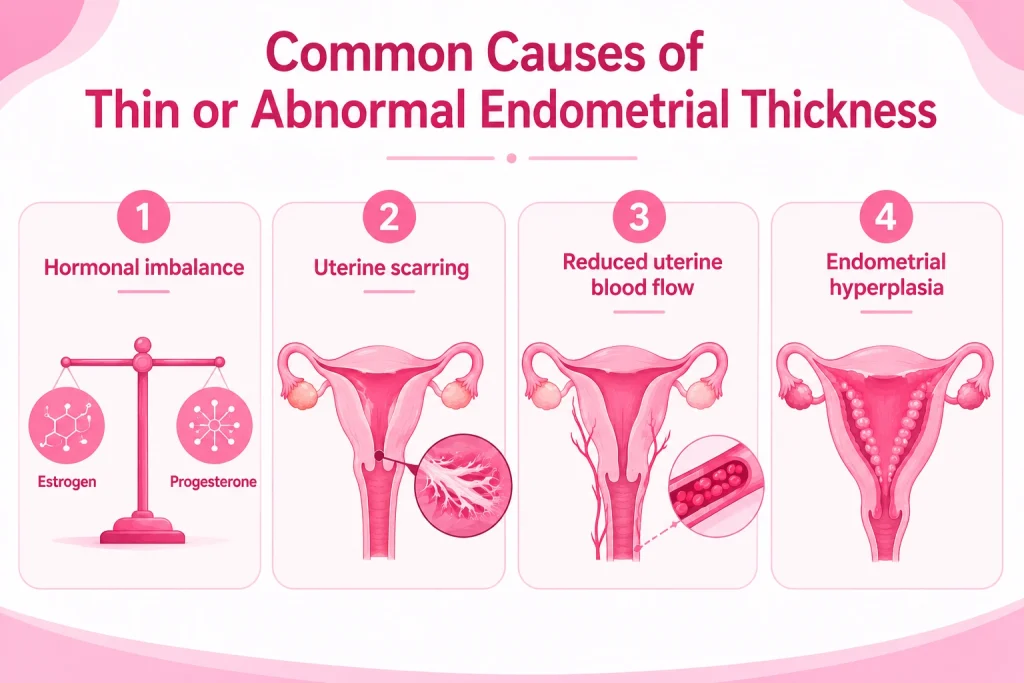
Common causes of thin or abnormal endometrial thickness
1. Hormonal imbalance
Estrogen helps the lining grow, while progesterone prepares it for implantation. Conditions such as PCOS, thyroid disorders, premature ovarian insufficiency, or ovulation dysfunction can interfere with normal endometrial development.
2. Uterine scarring
Previous procedures like D&C, fibroid surgery, or uterine infection may lead to scar tissue inside the uterus. Some women notice lighter periods afterward and do not initially connect the change with fertility difficulty months or years later.
3. Reduced uterine blood flow
Poor circulation to the uterus may contribute to a thinner endometrium in some patients. This area remains medically nuanced because research on blood-flow-targeted therapies is mixed, and responses vary significantly between individuals.
4. Endometrial hyperplasia
A very thick lining may also require evaluation, especially after menopause.
Current guidance from the American College of Obstetricians and Gynecologists notes that postmenopausal bleeding should be investigated because abnormal thickening can sometimes reflect endometrial hyperplasia or, less commonly, cancer (Source: American College of Obstetricians and Gynecologists).
Also Read: Factors That Affect Endometrial Thickness
Signs and symptoms
Women with excessively thin or thick endometrium may notice the following changes:
- Vaginal bleeding occurs after menopause.
- Spotting on the vagina, especially between ongoing menstrual cycles, is visible.
- Irregular bleeding during the menstrual cycle. There might be variations in the heaviness and duration of the periods.
- Might find it difficult to conceive or face recurring miscarriages.
- The menstrual cycle is shorter than 21 days or longer than 38 days.
If you are seeing any of the following signs or symptoms, it is important to consult your physician. This is especially important if you are planning a pregnancy soon. The doctor will recommend the right course of treatment so that you do not face difficulty in conceiving.
Can you get pregnant with thin endometrial thickness?
Yes, many women still become pregnant with a thinner lining. This surprises patients because internet discussions often make fertility sound dependent on one exact measurement. Real clinical practice is rarely that absolute.
Implantation also depends on:
- Embryo quality
- Ovulation timing
- Hormonal support
- Egg quality
- Maternal age
- Uterine health
- Blood flow to the uterus
Some women with a 6 mm endometrium conceive naturally. Others with measurements considered “ideal” may still need fertility treatment support.
What doctors usually check next
If endometrial thickness remains persistently low, doctors may recommend additional evaluation to understand why the lining is not developing normally.
Testing may include:
- Hormone evaluation
- Ovulation tracking
- Hysteroscopy
- Repeat ultrasound scans
- Blood-flow assessment
- Evaluation for uterine adhesions or polyps
Patients are often surprised that treatment may take several cycles rather than improving immediately in one month. The underlying cause usually determines how quickly the lining responds.
Endometrial thickness treatment
1. Estrogen therapy
Doctors sometimes prescribe oral, vaginal, or injectable estrogen during fertility treatment to help stimulate endometrial growth.
2. Progesterone support
Progesterone helps stabilize the lining after ovulation and plays an important role in implantation support.
3. Hysteroscopy for scar tissue
If scarring or adhesions are suspected, hysteroscopy allows doctors to directly examine the uterine cavity and sometimes remove abnormal tissue.
4. Managing underlying conditions
Treating thyroid disorders, PCOS, insulin resistance, chronic inflammation, or hormonal imbalance may improve endometrial development over time.
5. Lifestyle factors
Smoking, uncontrolled diabetes, chronic stress, and poor sleep may indirectly affect reproductive health and hormone regulation.
Still, patients should be cautious about supplements advertised online as “guaranteed” ways to thicken the lining naturally. Many claims lack strong clinical evidence.
What endometrial thickness looks like during early pregnancy
Some patients search for “gestational endometrium” or “endometrial pregnancy” after receiving an ultrasound report early in pregnancy.
During very early pregnancy, the endometrium continues thickening under hormonal influence to support implantation and fetal development. Ultrasound findings change quickly in the first few weeks as the gestational sac becomes visible.
A thickened lining alone does not confirm pregnancy, though. Doctors usually interpret the scan together with symptoms, hCG levels, and timing from ovulation or embryo transfer.
When you should speak with a fertility specialist
You should consider medical evaluation if you experience:
- Difficulty conceiving after regular attempts
- Recurrent miscarriage
- Extremely light periods
- Bleeding between cycles
- Repeated failed IVF transfers
- Bleeding after menopause
- Persistent pelvic pain
A fertility specialist can help determine whether the endometrium size for pregnancy is truly contributing to conception difficulty or whether another reproductive factor deserves closer attention.
References
- American Society for Reproductive Medicine: Does the Endometrium Play a Major Role in Endometriosis-Associated Infertility
- National Center for Biotechnology Information : Age-related uterine changes and its association with poor reproductive
- https://www.mayoclinic.org/diseases-conditions/female-infertility
- National Health Service UK : Irregular periods and fertility concerns
- American College of Obstetricians and Gynecologists : Guidance on Evaluation of Postmenopausal Bleeding


















 No need to worry, your data is 100% safe with us!