


Both aim to help you become a parent, but the actual steps, the timeline, and the success rates are quite different. Here is a simple guide to help you understand the difference between IUI and IVF, making your next doctor’s visit a little less stressful.
Key Takeaways
- IUI Places Prepared Sperm Inside the Uterus – Fertilisation still happens naturally inside the body, making IUI a simpler treatment with fewer steps.
- IVF Fertilises the Egg and Sperm in a Lab – Eggs are collected, fertilised with sperm in a laboratory, and the resulting embryo is transferred to the uterus.
- IUI Is Simpler and Less Expensive Than IVF – The page lists IUI at about ₹10,000–₹20,000 per attempt, compared with ₹1.5 lakh–₹2.5 lakh or more for IVF.
- IUI Needs at Least One Open Fallopian Tube – IVF can bypass blocked fallopian tubes because fertilisation takes place outside the body.
- IVF May Be Recommended for More Complex Fertility Problems – The page lists blocked fallopian tubes, severe male infertility, moderate to severe endometriosis, advanced maternal age, and multiple failed IUI cycles among situations where IVF may be recommended.
What exactly is IUI (Intrauterine Insemination)?
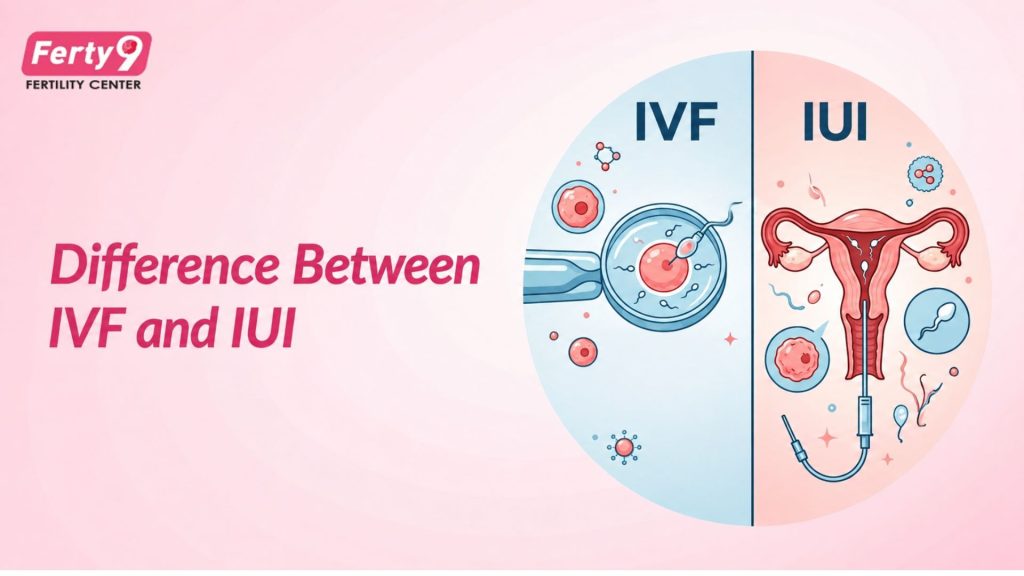
IUI is usually the first, gentle step many couples try when they need a little help getting pregnant. It is a very quick and simple process. Right around the time your body is ready to release an egg, your doctor takes a carefully prepared sample of your partner’s sperm and gently places it directly into your womb using a tiny, soft tube.
Think of it as giving the sperm a helpful “head start” by placing it exactly where it needs to be. But the real magic—the moment the sperm and egg actually meet—still happens completely naturally on its own inside your body.
What exactly is IVF (In Vitro Fertilisation)?
IVF is a slightly more involved process than IUI. The biggest difference is that the sperm and egg don’t meet inside your body—instead, they are brought together in a secure, carefully monitored lab.
First, you will take some helpful medicine that encourages your body to grow multiple healthy eggs. When the time is right, your doctor will gently collect these eggs while you take a quick, comfortable nap. Next, the eggs and sperm are placed together in a safe dish to combine and grow. After our lab team watches them develop for a few days, the absolute healthiest embryo is gently placed right back into your womb so it can attach and continue to grow.
What is the primary difference between IUI and IVF?
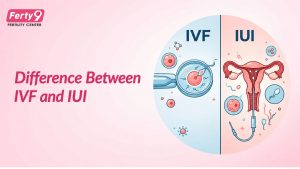
The easiest way to understand the true difference between IUI and IVF is by looking at where the magic actually happens. Here is a simple, side-by-side look at what you can expect from each option:
| What to Expect | IUI (The Simpler Route) | IVF (The More Advanced Step) |
| Where do the sperm and egg meet? | Naturally, right inside your body. | Outside the body, in a safe and carefully watched lab. |
| What is the process like? | Very simple and quick, with absolutely no surgery required. | It takes a few extra steps, including a gentle procedure to gather your eggs. |
| Will you need to be put to sleep? | No, you stay completely awake. It feels very similar to a routine check-up! | Yes, you will take a short, comfortable nap while the doctor collects your eggs so you don’t feel a thing. |
| How long does one try take? | About 2 to 3 weeks (similar to your natural monthly cycle). | About 4 to 6 weeks. |
| What are the chances of success? | Around 10% to 20% for each try. | Much higher, around 40% to 50%+ for each try (depending on your age). |
| General Cost in India | Very budget-friendly (usually between ₹10,000 and ₹20,000 per try). | A bigger investment (usually between ₹1,50,000 and ₹2,50,000+ per try). |
Who is IUI Best For?
IUI is usually the go-to recommendation for couples who just need a gentle push rather than a complex procedure. Doctors often suggest starting with IUI if you are dealing with:
- No clear reason for the delay: When all your tests come back perfectly normal, but you are still having trouble getting pregnant.
- Sperm that needs a little boost: If your partner has a slightly lower sperm count, or the sperm just need some extra help swimming exactly where they need to go.
- Natural roadblocks: Sometimes, a woman’s natural fluids can accidentally act like a barrier, making it hard for the sperm to swim past the cervix. IUI completely bypasses this issue!
- Irregular cycles (like PCOS): If you have a condition like PCOS, doctors can easily pair IUI with simple medicines that help your body release an egg right on time.
(Important note: For IUI to be successful, you must have at least one clear, open pathway-fallopian tube so the egg and sperm can naturally meet inside your body.)
Who should choose IVF?
Because it is a highly controlled process, IVF bypasses many natural biological hurdles. Your doctor will likely recommend bypassing IUI and going straight to IVF if you have:
- Blocked Fallopian Tubes: Since fertilization happens in the lab, the tubes are not needed.
- Severe Male Infertility: Extremely low sperm count or poor shape (morphology).
- Endometriosis: Moderate to severe cases that affect the ovaries or tubes.
- Advanced Maternal Age: Women over the age of 35 who are looking for the highest chance of success per cycle.
- Multiple Failed IUI Cycles: If 3 to 4 IUI cycles have not resulted in pregnancy.
Are There Any Risks with These Treatments?
Both options are very safe and closely monitored by doctors, but just like any medicine, they come with a few things to keep in mind:
- IUI (The chance of multiples): The main thing to watch out for with IUI is the chance of having twins or triplets! Because this process relies on your body’s natural timing, if the medicine helps you grow three or four eggs, there is no way to control how many of them get fertilised.
- IVF (Feeling bloated): IVF uses stronger medicine to help your body grow multiple eggs. Very rarely, your body can overreact to this medicine, leaving you feeling quite swollen, bloated, and uncomfortable. Thankfully, clinics today monitor you so closely that this is incredibly rare. On the bright side, IVF gives your doctor complete control over the chance of twins, since they choose exactly how many tiny embryos to place back inside your womb gently.
Which Process is More Painful?
Worrying about pain is completely normal when you are looking into fertility treatments. Fortunately, neither option is highly painful:
- IUI Pain Level: IUI doesn’t involve any surgery at all. Most women say it just feels like a regular, routine pelvic exam. You might have a tiny bit of cramping for a day, but you can usually go right back to your normal daily routine immediately.
- IVF Pain Level: IVF asks a little more of your body. The daily medicine shots can cause some mild bruising, bloating, and mood swings. When it is time to collect the eggs, you will need a quick procedure, but you will take a short, comfortable nap so you won’t feel a thing. Afterwards, you might just have period-like cramps for a few days.
How Do You Choose the Right Path?
Choosing between the two really comes down to your unique situation, your age, and your family’s budget.
Many couples prefer to try IUI two or three times first because it is much easier on the body and very budget-friendly. However, if time is a concern, or if you have physical hurdles (like blocked pathways where the egg and sperm cannot naturally meet), jumping straight to IVF can actually save you time and emotional exhaustion in the long run.
The best step you can take is to have an open, honest chat with your doctor to map out a plan that feels comfortable and right for you.
References
IUI vs. IVF: Which Fertility Treatment Is Right for You? – Healthline
What Is the Difference Between IUI and IVF? – WebMD
IUI vs. IVF: Understanding the Differences – Verywell Family
https://www.verywellfamily.com/iui-vs-ivf-differences-5203099
Intrauterine insemination (IUI) vs in vitro fertilization (IVF) – Medical News Today
















 No need to worry, your data is 100% safe with us!