


Blastocyst Culture
Waiting for your embryos to develop is one of the most critical parts of the IVF journey. Blastocyst cultureis an advanced laboratory technique designed to give you the highest possible chance of taking home a healthy baby.
In traditional IVF, embryos are often transferred to the womb just two or three days after fertilization. Blastocyst culture allows the embryos to grow in a highly controlled incubator for five to six days. By waiting for the embryo to reach this advanced stage (known as a blastocyst), our embryologists can clearly identify the healthiest embryo that is most likely to result in a successful pregnancy.

Why is Blastocyst Culture the Preferred Choice?
Allowing the embryo those few extra days to develop makes a remarkable difference in fertility treatments. This approach is highly preferred for several key reasons:
Mimics the Natural Pregnancy Timeline
In a natural pregnancy, an embryo reaches the uterus around day five. A day-5 embryo transfer closely matches this natural process, creating an optimal environment for implantation.
Higher Implantation Success
Embryos that continue to develop until day five are generally stronger and more likely to implant successfully, improving the chances of pregnancy with each transfer.
Reduced Risk of Multiple Pregnancy
Selecting the healthiest day-5 embryo allows for confident single embryo transfer, significantly reducing the risks associated with twin or triplet pregnancies.
Safer & More Accurate Genetic Testing
A day-5 embryo has more cells available for biopsy, making preimplantation genetic testing (PGT) safer for the embryo and more accurate in detecting genetic conditions.
The Step-by-Step Process of Blastocyst Culture
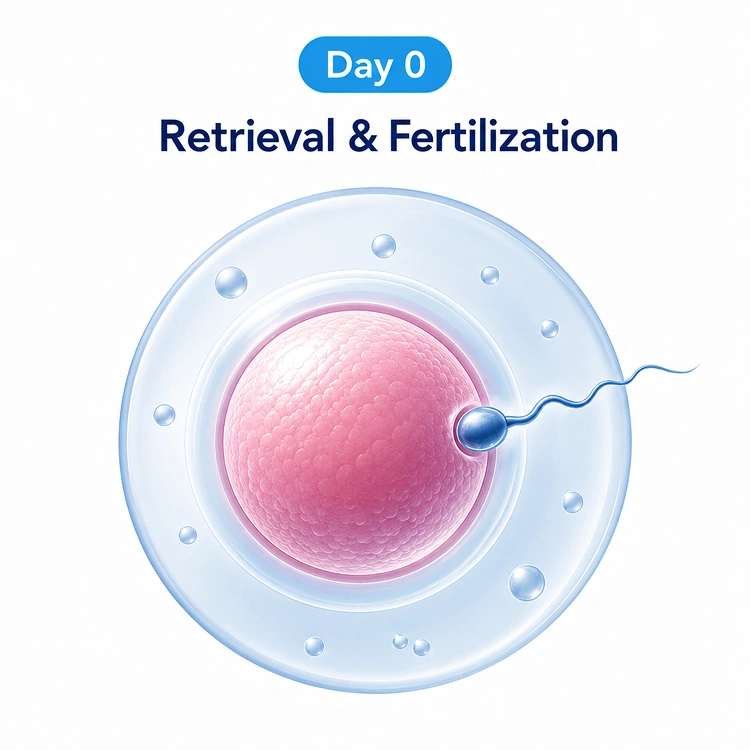
Retrieval & Fertilization
The mature egg is gently retrieved and successfully fertilized with carefully selected sperm in the laboratory, marking the beginning of embryo development.
How We Grade and Select the Best Embryo
Selecting the right embryo involves more than just looking at its size. Our expert embryologists use a comprehensive grading system to evaluate three crucial components of the blastocyst:
| What We Check | Grade Range | Why It Matters |
| Expansion Level | 1 to 6 | Shows how well the embryo is growing and expanding. |
| Inner Cell Mass | A to D | Evaluates the quality of the cells that will eventually develop into your baby. |
| Outer Layer (Trophectoderm) | A to D | Checks the quality of the cells that will help the embryo safely attach to the womb and form the placenta. |
Who Benefits Most From This Technique?
While this advanced technique improves outcomes across the board, it is particularly life-changing for specific groups of patients:
Patients with Previous Unsuccessful IVF Attempts
If you have faced the heartbreak of two or more failed IVF cycles, blastocyst culture offers renewed hope. Watching the embryos for a full five days provides doctors with a much clearer understanding of their development and quality, enabling better embryo selection and improving the chances of successful implantation.
Families Seeking a Safe, Single Pregnancy
For mothers who want to minimise the risks of carrying multiples, Elective Single Embryo Transfer (eSET) is often recommended. By transferring a high-quality day-5 blastocyst, excellent pregnancy rates can be achieved while prioritising the safety of both mother and baby.
- Single Blastocyst Transfer: Pregnancy rate of 40%–60% with only about a 2% chance of identical twins.
- Double Blastocyst Transfer: Pregnancy rate of up to 75%, but with a higher risk of multiple pregnancies (38% twins and 2% triplets).
Candidates for Genetic Testing
If you are over 35, have a history of recurrent miscarriages, or have inherited genetic conditions in your family, your doctor may recommend genetic testing. Blastocyst culture is essential because a day-5 embryo provides enough cells for accurate genetic screening without compromising the embryo's future growth.
Are There Any Risk Factors or Limitations?
While blastocyst culture offers excellent success rates, we first evaluate whether it is the most suitable option for your individual fertility journey. The main limitation is that not every fertilised egg develops into a healthy day-5 blastocyst.
Not all embryos reach the blastocyst stage: Some embryos naturally stop developing before day 5, particularly when egg numbers or embryo quality are low.
Limited embryos for transfer: In some cases, no embryos may survive to the blastocyst stage, leaving none available for transfer.
Personalised treatment decisions: We carefully assess your age, ovarian reserve, embryo quality, and medical history before recommending a day-5 blastocyst transfer to maximise safety and success.
What is the Success Rate of Blastocyst Culture?
One of the most comforting aspects of blastocyst culture is the high level of confidence it gives both doctors and couples. Because the embryos that reach day five are proven to be the strongest survivors, the chances of them successfully attaching to the womb are significantly higher.
In top-tier clinics across India, transferring a high-quality day-5 blastocyst typically yields a remarkable success rate per transfer, which is a remarkable improvement over traditional day-3 transfers. However, it is important to remember that individual success rates will naturally vary based on the mother’s age, the quality of the egg and sperm, and the overall health of the uterus.
How Much Does Blastocyst Culture Cost in India?
Financial planning is a very real part of any fertility journey, and understanding the costs upfront brings peace of mind.
In India, a standard IVF cycle generally ranges from ₹1,50,000 to ₹2,50,000. Because blastocyst culture requires keeping the embryos in the laboratory for a longer period using highly advanced incubators and specialised culture media, some clinics charge a small additional fee for this extended care, usually ranging between ₹15,000 and ₹30,000. However, many reputed, patient-focused clinics now include the cost of blastocyst culture within their comprehensive IVF packages to ensure every couple gets the highest standard of care without worrying about hidden lab fees.
Why Choose Ferty9 Fertility Clinic for Blastocyst Culture?
Choosing where to trust your fertility journey is one of the most deeply personal decisions you will ever make. At Ferty9, we combine cutting-edge embryology with gentle, compassionate care to give you the absolute best chance of bringing home a healthy baby. Here is exactly why families across India trust Ferty9 for their blastocyst culture and IVF treatments:
Patient Stories
Nothing inspires us more than the success stories of our patients


We had a good nd happy experience. Dr Mrudula priyanka was so good nd treated well. We are happy that we got pregnancy positive n...
Dr. Mrudula mam was soo kind and supporting to us…we are so happy for getting pregnancy positive we are very much thankful to Dr.Mrudula mam...
Mrudhula madam is very good doctorShe giver full comfort to her patientsAnd all the explanation are very good n after taking treatment by her we...
We are very happy that we got pregnant positive after taking treatment by Dr.Mrudula Madam n madam’s service is very good and Gre: Veronica has...
We visited Ferty9 Fertility Centre and had a very good experience. Dr. Mrudula madam treated us with great care and explained everything clearly. The entire...

Blastocyst culture is a laboratory method used during IVF treatments to allow embryos to develop for a more extended period before transfer. We perform blastocyst transfer to increase the chances of implantation. Additionally, if the embryo can reach the blastocyst level in the lab, it is considered to be genetically viable, which improves the pregnancy rate and allows for single embryo transfer.
Blastocyst culture is used in IVF to improve the selection process of embryos for transfer. By allowing embryos to develop longer, embryologists can identify the embryos with the highest chances of successful implantation and pregnancy. Blastocyst culture provides a more accurate assessment of embryo quality, as only the embryos that have reached the blastocyst stage are selected for transfer. This technique increases the success rates of IVF treatments and reduces the chance of multiple pregnancies by transferring a smaller number of high-quality embryos.
Blastocyst transfer differs from traditional Day 2 or Day 3 embryo transfer in terms of embryo development stage at the time of transfer. In traditional embryo transfer, embryos are transferred into the uterus on either Day 2 or Day 3 after fertilisation, when they are still in the early stages of development. In contrast, blastocyst transfer involves transferring embryos on Day 5 or 6, when they have reached the blastocyst stage of development. This extended culture period allows embryologists to select the healthiest embryos with a higher chance of successful implantation and pregnancy.
Blastocyst transfer offers several advantages over traditional embryo transfer. By allowing embryos to develop for a more extended period, fertility specialists can accurately assess the quality of the embryos and select the healthiest ones for transfer. It improves the likelihood of successful implantation and pregnancy. Blastocyst transfer also reduces the risk of multiple pregnancies, as embryologistss can transfer a smaller number of high-quality embryos. Furthermore, blastocyst transfer provides a more natural and physiologically appropriate timeframe for embryo development, increasing the chances of a successful outcome.
The success rates of blastocyst transfer vary and depend on various factors, including the quality of the embryos, the age of the woman, and the specific circumstances of the individual or couple. However, studies have shown that blastocyst transfer generally results in higher pregnancy rates than traditional Day 2 or Day 3 embryo transfer. By allowing embryos to develop until the blastocyst stage, embryologists can select the healthiest embryos for transfer, increasing the possibility of successful implantation and pregnancy. The success rates of blastocyst transfer continue to improve with advancements in reproductive technology and the use of PGT.
Blastocyst transfer significantly impacts the number of embryos transferred during an IVF cycle. By allowing embryos to develop until the blastocyst stage, embryologists can accurately assess their quality and select the healthiest embryos for transfer. This process enables them to transfer fewer embryos while maintaining high success rates. The ability to transfer single embryo reduces the risk of multiple pregnancies, which is associated with increased complications for both the mother and the babies. Blastocyst transfer provides individuals and couples a more controlled and safer approach to achieving a successful pregnancy.
Blastocyst culture does not increase the risk of multiples (twins, triplets) compared to traditional Day 2 or Day 3 embryo transfer. Blastocyst transfer reduces the chance of multiple pregnancies by allowing embryologists to select one healthiest embryos for transfer. By transferring high-quality embryo, the chances of a single, successful pregnancy is maximised while minimising the risks associated with multiple pregnancies. Blastocyst culture, in combination with PGT, provides individuals and couples with a safer and more controlled approach to achieving their dream of parenthood.

Content Last Reviewed on: August 4, 2026