


Trying to conceive can bring a mix of hope, excitement, and uncertainty. Many couples look beyond medical treatments and explore lifestyle practices that may support reproductive health naturally. Yoga is one of the most widely practiced mind-body approaches because it combines movement, breathing, relaxation, and stress reduction, all of which can influence overall well-being.
At Ferty9, fertility specialists often emphasize that reproductive health is influenced by multiple factors, including age, hormonal balance, lifestyle habits, underlying medical conditions, and emotional well-being. While yoga is not a treatment for infertility, it may complement a healthy lifestyle and support both men and women during their fertility journey.
- Yoga may support fertility by reducing stress, improving circulation, and promoting overall physical and emotional well-being, though it does not directly treat infertility.
- Certain yoga poses can help improve flexibility, encourage relaxation, and increase blood flow to the pelvic region, which plays an important role in reproductive health.
- Fertility-friendly yoga can benefit both women and men by supporting hormonal health, reducing stress-related effects on the body, and encouraging healthier lifestyle habits.
- Yoga works best as part of a broader fertility plan that may include proper nutrition, exercise, medical evaluation, and fertility treatment when needed.
- Persistent difficulty conceiving should be evaluated by a fertility specialist because yoga alone cannot address conditions such as blocked fallopian tubes, severe male factor infertility, or advanced endometriosis.
15 Yoga Asanas for Fertility
1. Butterfly Pose (Baddha Konasana)
Butterfly Pose is one of the most popular fertility-supportive yoga postures because it gently opens the hips and inner thighs.
How to perform:
- Sit upright with your feet together.
- Allow your knees to fall outward.
- Hold your feet and sit tall.
- Gently move your knees up and down for 30 to 60 seconds.
Potential benefits:
- Improves hip flexibility
- Encourages pelvic mobility
- Promotes relaxation
2. Child’s Pose (Balasana)
Child’s Pose is a restorative posture that helps calm the nervous system.
How to perform:
- Kneel on the floor.
- Sit back on your heels.
- Extend your arms forward and lower your torso.
- Rest for one to three minutes.
Potential benefits:
- Relieves tension
- Encourages deep breathing
- Supports stress reduction
3. Cat-Cow Pose (Marjaryasana-Bitilasana)
This gentle movement increases spinal mobility and body awareness.
How to perform:
- Begin on hands and knees.
- Arch your back while lifting your head.
- Round your spine while tucking your chin.
- Continue slowly for several breaths.
Potential benefits:
- Improves flexibility
- Encourages circulation
- Reduces lower back stiffness
4. Bridge Pose (Setu Bandhasana)
Bridge Pose strengthens the lower body while opening the front of the hips.
How to perform:
- Lie on your back with knees bent.
- Place feet hip-width apart.
- Lift your hips toward the ceiling.
- Hold for 20 to 30 seconds.
Potential benefits:
- Strengthens pelvic muscles
- Supports posture
- Encourages circulation
5. Legs-Up-the-Wall Pose (Viparita Karani)
This restorative pose is often recommended for relaxation.
How to perform:
- Lie on your back beside a wall.
- Extend your legs upward against the wall.
- Relax for five to ten minutes.
Potential benefits:
- Reduces stress
- Relieves tired legs
- Encourages relaxation
6. Cobra Pose (Bhujangasana)
Cobra Pose gently stretches the abdomen and chest.
How to perform:
- Lie face down.
- Place hands beneath your shoulders.
- Lift your chest while keeping elbows slightly bent.
- Hold briefly and lower slowly.
Potential benefits:
- Improves posture
- Strengthens back muscles
- Promotes flexibility
7. Seated Forward Bend (Paschimottanasana)
This pose encourages mindfulness and relaxation.
How to perform:
- Sit with legs extended.
- Reach toward your feet.
- Lengthen through your spine.
- Hold comfortably.
Potential benefits:
- Encourages calmness
- Improves flexibility
- Supports stress management
8. Garland Pose (Malasana)
Garland Pose is a deep squat that promotes hip mobility.
How to perform:
- Stand with feet slightly wider than hips.
- Lower into a squat.
- Bring palms together at the chest.
- Maintain a comfortable position.
Potential benefits:
- Opens the hips
- Improves pelvic flexibility
- Strengthens lower body muscles
9. Bound Angle Reclining Pose (Supta Baddha Konasana)
This restorative variation of Butterfly Pose is commonly included in fertility yoga classes.
How to perform:
- Lie on your back.
- Bring the soles of your feet together.
- Allow knees to open outward.
- Relax and breathe deeply.
Potential benefits:
- Encourages relaxation
- Opens the hips
- Supports mindfulness
10. Warrior II (Virabhadrasana II)
Warrior II builds strength and stability.
How to perform:
- Step your feet wide apart.
- Bend one knee.
- Extend your arms parallel to the floor.
- Hold and switch sides.
Potential benefits:
- Builds endurance
- Strengthens legs
- Improves balance
11. Triangle Pose (Trikonasana)
Triangle Pose stretches multiple muscle groups simultaneously.
How to perform:
- Stand with feet wide apart.
- Extend one arm toward the floor.
- Reach the opposite arm upward.
- Hold and repeat on both sides.
Potential benefits:
- Enhances flexibility
- Improves balance
- Supports circulation
12. Pigeon Pose (Eka Pada Rajakapotasana)
This pose provides a deep hip stretch.
How to perform:
- Bring one knee forward while extending the opposite leg behind.
- Lower your hips comfortably.
- Hold and breathe deeply.
Potential benefits:
- Releases hip tension
- Encourages flexibility
- Supports mobility
13. Happy Baby Pose (Ananda Balasana)
Happy Baby Pose gently stretches the hips and lower back.
How to perform:
- Lie on your back.
- Hold the outer edges of your feet.
- Draw your knees toward your chest.
- Relax into the stretch.
Potential benefits:
- Relieves tension
- Encourages relaxation
- Improves flexibility
14. Corpse Pose (Savasana)
Although simple, Savasana is one of the most valuable poses for stress management.
How to perform:
- Lie flat on your back.
- Relax your arms and legs.
- Focus on slow breathing.
- Remain still for five to ten minutes.
Potential benefits:
- Promotes mental calmness
- Encourages recovery
- Supports mindfulness
15. Supported Bridge Pose
This gentle variation uses a yoga block or cushion.
How to perform:
- Lie on your back with knees bent.
- Lift your hips slightly.
- Place support beneath your pelvis.
- Relax comfortably.
Potential benefits:
- Encourages relaxation
- Supports gentle stretching
- Suitable for restorative practice
Can Yoga Improve Fertility?
Many people wonder whether yoga can increase their chances of getting pregnant. The answer is more nuanced than a simple yes or no.
Current research suggests that yoga may help reduce stress, improve mental health, and support overall wellness, all of which can be beneficial when trying to conceive. Chronic stress has been associated with hormonal changes that may affect reproductive function in some individuals (Source: National Institutes of Health).
Yoga’s greatest fertility-related benefit may be its ability to help people manage the emotional demands of conception attempts, fertility investigations, and assisted reproductive treatments. Many patients report sleeping better, feeling calmer, and becoming more connected to their bodies after establishing a regular yoga practice.
That said, yoga should be viewed as a supportive practice rather than a fertility treatment. Conditions such as blocked fallopian tubes, severe sperm abnormalities, or certain hormonal disorders usually require medical evaluation and targeted treatment.
How Yoga May Support Reproductive Health
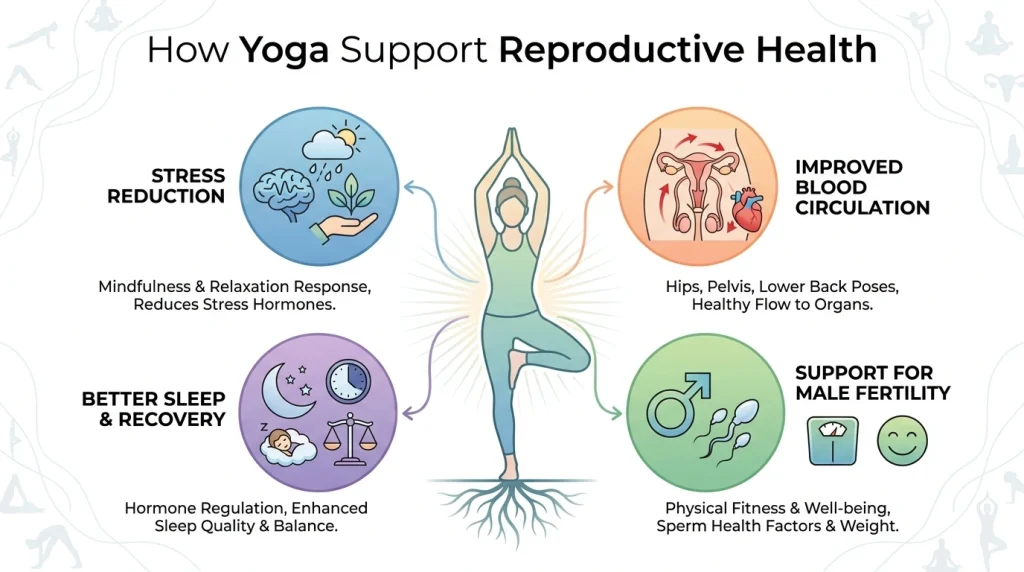
Yoga influences multiple systems within the body that can indirectly support reproductive wellness.
Stress Reduction
Stress alone does not cause infertility in most cases. However, high stress levels can affect sleep quality, mood, relationships, and overall health. Yoga encourages mindfulness and activates the body’s relaxation response, helping reduce stress hormones that may interfere with normal bodily functions.
Improved Blood Circulation
Several yoga poses gently stretch and open the hips, pelvis, and lower back. This movement may support healthy circulation throughout the body, including the reproductive organs.
Better Sleep and Recovery
Sleep plays an important role in hormone regulation. Many people who practice yoga regularly report improvements in sleep quality, which may contribute to overall health and hormonal balance.
Support for Male Fertility
Male fertility depends on factors such as sperm count, motility, morphology, hormone levels, and general health. Stress management, regular physical activity, and maintaining a healthy weight can support reproductive function. Yoga may contribute to these goals by promoting physical fitness and emotional well-being.
What a Fertility Yoga Routine Might Look Like
Many people assume longer yoga sessions produce better results. In reality, consistency matters more than duration.
A simple 20- to 30-minute routine performed three to five times weekly may be easier to maintain than occasional lengthy sessions. Many fertility-focused routines combine gentle stretching, breathing exercises, mindfulness, and restorative poses rather than intense physical workouts.
What often surprises patients is that the most beneficial part of fertility yoga may not be the stretching itself. The opportunity to slow down, disconnect from daily stressors, and focus on mental well-being can be equally valuable.
Common Misconceptions About Yoga and Fertility
Yoga Does Not Cure Infertility
One of the biggest misconceptions is that yoga can reverse all fertility problems. While yoga may support overall health, it cannot remove blocked fallopian tubes, correct severe sperm abnormalities, or replace fertility treatment when medically necessary.
More Intense Yoga Is Not Always Better
Extremely vigorous exercise may not be appropriate for everyone trying to conceive. Moderate, balanced activity is generally easier to sustain and less likely to contribute to physical strain.
Results Are Not Immediate
Some people expect noticeable changes within days. Fertility is influenced by many factors, including age, genetics, reproductive conditions, and lifestyle habits. Yoga should be viewed as a long-term wellness practice rather than a quick solution.
When to Seek Fertility Evaluation
If pregnancy has not occurred after 12 months of regular unprotected intercourse for women under 35, fertility evaluation is generally recommended. For women aged 35 and older, evaluation is often advised after six months of trying (Source: American College of Obstetricians and Gynecologists).
Men should also be evaluated because male factors contribute to infertility in approximately half of all couples experiencing fertility challenges (Source: American Society for Reproductive Medicine).
Seeking help early can identify treatable issues and provide clarity about the most appropriate next steps.
References
- National Institutes of Health. Stress and Reproductive Health
- American College of Obstetricians and Gynecologists. Evaluating Infertility
- American Society for Reproductive Medicine. Infertility Overview and Male Factor Infertility
- World Health Organization. Infertility Fact Sheet
- National Center for Complementary and Integrative Health. Yoga: What You Need To Know






















 No need to worry, your data is 100% safe with us!