



Understanding your period cycle is an important part of maintaining reproductive and hormonal health. Whether you are planning a pregnancy, tracking ovulation, or simply trying to predict your next period, learning how to calculate period cycle accurately can help you better understand your body.
Many women experience confusion around delayed periods, irregular cycles, or changing symptoms every month. Tracking your menstrual cycle regularly can help identify patterns, improve fertility awareness, and even detect underlying health concerns early.
Today, many women use a period cycle calculator, menstrual cycle tracker apps, or a simple calendar method to monitor their cycles and fertile days more effectively.
What Is a Period Cycle?
A period cycle, also known as the menstrual cycle, is counted from the first day of one period to the first day of the next period.
This cycle is controlled by hormones and prepares the body for pregnancy every month. A healthy menstrual cycle usually ranges between 21 to 35 days, although the average cycle length is around 28 days.
The menstrual cycle mainly includes four stages:
- Menstrual phase
- Follicular phase
- Ovulation phase
- Luteal phase
Every woman’s cycle is different, and slight variations from month to month are common.
Cycle length can naturally vary by a few days due to stress, travel, sleep disturbances, illness, sudden weight changes, or hormonal fluctuations. Teenagers and women approaching their late 30s or 40s may also notice greater menstrual cycle variability because ovulation patterns can become less predictable during these stages.
Also read: Four Phases of Menstrual Cycle
Why Is Tracking Your Period Cycle Important?
Tracking your cycle is not only useful for predicting your next period but also for understanding your reproductive health better.
Monitoring women’s period cycle days can help:
- Predict upcoming periods
- Identify fertile days
- Track ovulation timing
- Detect irregular periods
- Understand hormonal changes
- Plan pregnancy naturally
- Monitor PMS symptoms
Doctors often recommend tracking cycles for at least 3–6 months to identify consistent patterns or abnormalities.
In fertility consultations, doctors often review not only cycle length but also bleeding duration, flow intensity, ovulation symptoms, and PMS patterns because these details may provide early clues about hormonal imbalance, thyroid disorders, PCOS, or ovulatory dysfunction.
How to Calculate Your Period Cycle
Learning how to calculate period cycle is simple and can be done manually or with a period cycle calculator.
Step 1: Mark the First Day of Your Period
The first day of menstrual bleeding is considered Day 1 of your cycle.
Step 2: Count the Days Until Your Next Period
Count every day from the start of your current period until the day before your next period begins.
Step 3: Identify Your Cycle Length
The total number of days gives your menstrual cycle length.
Example:
- First day of current period: March 1
- First day of next period: March 29
Your cycle length = 28 days
This process forms the basis of most period cycle calculation methods used in fertility tracking tools and menstrual health apps.
Using a Period Cycle Calculator
A period cycle calculator helps estimate:
- Your next period date
- Ovulation day
- Fertile window
- Average cycle length
Many women prefer using a period cycle date calculator because it simplifies cycle tracking and provides reminders for upcoming periods and ovulation days.
A period cycle length calculator can also help women with irregular periods monitor changes more accurately over time.
How to Predict Your Next Period Date
Once you know your average cycle length, estimating your next period becomes easier.
Formula:
Next Period Date = First Day of Last Period + Average Cycle Length
Example:
- Last period started on April 5
- Average cycle length = 30 days
Expected next period = May 5
Most period cycle days calculator tools follow this same calculation method.
How to Calculate Ovulation and Fertile Days Naturally
Ovulation generally occurs around 12–14 days before the next period starts.
However, ovulation does not always occur exactly in the middle of the cycle. Even women with regular periods may ovulate earlier or later in some months, which is why relying only on calendar calculations may not always accurately predict fertile days.
Example:
For a 30-day cycle:
30 – 14 = Day 16
Ovulation is likely to happen around Day 16.
Understanding Your Fertile Window
The fertile window usually includes:
- 5 days before ovulation
- Ovulation day
- 1 day after ovulation
This is considered the best time to conceive naturally.
Sperm can survive inside the female reproductive tract for up to 5 days under favorable conditions, which is why intercourse during the days leading up to ovulation may still result in pregnancy even if ovulation occurs slightly later than expected.
Many women use a monthly period cycle calculator, ovulation tracker, or fertility tracker to identify fertile days more accurately.
Common Signs of Ovulation
Some women notice physical symptoms around ovulation, including:
- Mild lower abdominal pain
- Increased cervical mucus
- Breast tenderness
- Increased libido
- Slight rise in body temperature
Tracking these signs alongside your menstrual calendar can improve fertility awareness and cycle understanding.
Doctors sometimes recommend combining symptom tracking with ovulation predictor kits or basal body temperature monitoring in women trying to conceive because app-based predictions alone may not always confirm actual ovulation.
How to Track Women’s Period Cycle Days Naturally
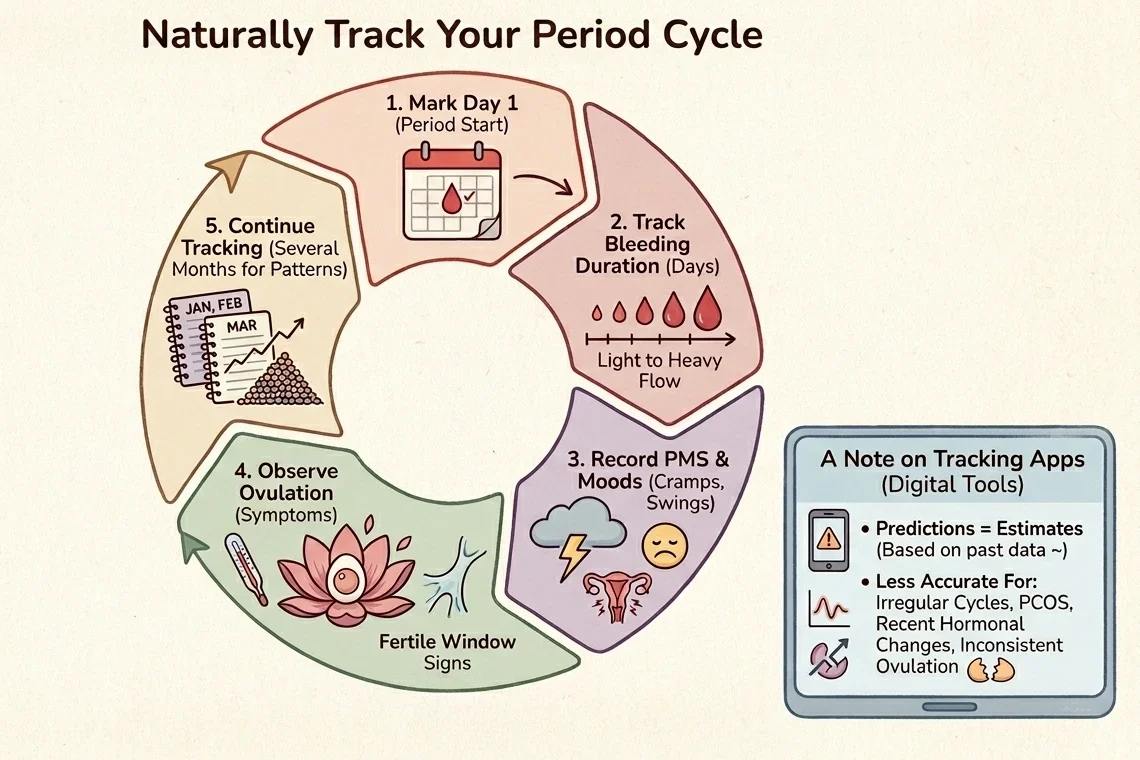
You do not always need advanced apps or tools to monitor your cycle effectively.
Here’s how many women naturally track their cycles:
- Mark the first day of each period
- Track bleeding duration
- Record PMS symptoms
- Note mood swings or cramps
- Observe ovulation symptoms
- Continue tracking for several months
Although period tracking apps are useful for identifying patterns, their predictions are estimates based on previous cycle data and may become less accurate in women with irregular cycles, PCOS , recent hormonal changes, or inconsistent ovulation.
Consistent tracking often provides better insights into hormonal and reproductive health.
Using Period Tracking Apps
Digital tracking tools have become increasingly popular for menstrual health monitoring.
Many apps work as a period cycle calculator and help users:
- Predict future periods
- Monitor fertile days
- Track PMS symptoms
- Record cycle irregularities
- Estimate ovulation dates
However, doctors often suggest combining app tracking with personal symptom monitoring for better accuracy.
How to Calculate Period Cycle for Irregular Periods
Women with irregular cycles may find period tracking slightly difficult, but monitoring patterns can still provide valuable insights.
Tips for irregular cycles:
- Track periods for at least 6 months
- Identify shortest and longest cycles
- Monitor ovulation symptoms
- Maintain a healthy lifestyle
- Consult a fertility specialist if irregularity continues
Irregular cycles may occur due to:
- PCOS
- Thyroid disorders
- Stress
- Hormonal imbalance
- Weight changes
- Excessive exercise
If your cycle is consistently shorter than 21 days or longer than 35 days, medical evaluation is recommended.
Many women ignore irregular periods initially, but early medical guidance can help identify underlying hormonal or reproductive conditions before they become more serious.
In some cases, irregular cycles may be the earliest visible sign of ovulation-related disorders, insulin resistance, thyroid imbalance, or reduced ovarian reserve, particularly when cycle changes appear suddenly after previously regular periods.
If you are experiencing irregular menstrual cycles or difficulty conceiving, consulting a fertility specialist early can help identify the underlying cause and improve treatment outcomes.
When Should You Consult a Doctor?
You should consult a gynecologist or fertility specialist if you experience:
- Severe period pain
- Heavy bleeding
- Frequently missed periods
- Sudden cycle changes
- Difficulty conceiving
- Very short or very long cycles
Early diagnosis and treatment can help improve reproductive health outcomes and prevent complications related to hormonal or ovulation disorders.
Commonly Asked Questions
1. What is considered a normal period cycle?
A normal menstrual cycle usually ranges between 21 to 35 days.
2. How does a period cycle calculator work?
A period cycle calculator estimates future periods and ovulation days using your previous cycle dates.
3. What is a period cycle length calculator?
A period cycle length calculator helps determine the average number of days between two periods.
4. Can stress affect women’s period cycle days?
Yes, stress can affect hormones, delay ovulation, and change cycle timing.
5. Is a monthly period cycle calculator accurate?
A monthly period cycle calculator provides estimated predictions based on previous cycle patterns, but occasional variations are normal.
6. Can irregular periods affect fertility?
Irregular periods may sometimes indicate ovulation problems, which can affect fertility. Consulting a fertility specialist can help identify the cause.
7. What are the best ways to track ovulation naturally?
Tracking cervical mucus, basal body temperature, cycle dates, and ovulation symptoms can help identify ovulation naturally.
Conclusion
Understanding your period cycle can help you take better control of your reproductive health and fertility awareness. Whether you use a calendar, journal, app, or period cycle calculator, consistent tracking helps you identify patterns and better understand your body.
Learning how to calculate period cycle, monitor ovulation, and track menstrual symptoms can also help detect irregularities early and improve overall health awareness.
If you experience persistent irregular periods, severe symptoms, or fertility concerns, consulting an experienced gynecologist or fertility specialist is always recommended.




















 No need to worry, your data is 100% safe with us!