


Noticing pink discharge during early pregnancy can be unsettling. Even a small amount of spotting is enough to make many women worry that something may be wrong with their pregnancy. While it’s natural to feel anxious, light pink discharge is relatively common during the first trimester and is often linked to normal changes that occur as your body adapts to pregnancy.
At Ferty9 Fertility Center, one of the first things our specialists assess when a patient reports spotting is not just the colour, but also the amount of bleeding, timing, associated symptoms, and ultrasound findings. These details provide a much clearer picture of what’s happening than colour alone. In many cases, pink discharge has a harmless explanation, but understanding when it needs medical attention can help you respond with confidence rather than fear.
- Light pink discharge during early pregnancy is common and is often caused by implantation, increased blood flow to the cervix, or mild cervical irritation rather than a problem with the pregnancy.
- The colour of the discharge is only one piece of the picture. The amount of bleeding, duration, and symptoms such as pain or dizziness are usually more important.
- Women who conceive through IVF may notice light spotting because vaginal progesterone medications and embryo transfer procedures can make the cervix more sensitive.
- Heavy bleeding, severe abdominal pain, one-sided pelvic pain, fainting, or passing tissue requires prompt medical evaluation to rule out serious complications.
- Most women who experience light spotting during the first trimester continue to have healthy pregnancies, but it’s always worth informing your healthcare provider so they can determine whether any assessment is needed.
Is Pink Discharge Normal During Early Pregnancy?
Light pink discharge during the first trimester often occurs because a very small amount of fresh blood mixes with normal vaginal discharge. Unlike menstrual bleeding, it is usually light, short-lived, and doesn’t increase in volume.
Research suggests that up to one in four women experience some degree of spotting during early pregnancy, and many of these pregnancies progress normally (Source: American College of Obstetricians and Gynecologists). Spotting doesn’t automatically mean miscarriage, although it should never be ignored.
The most important questions your doctor will consider are:
- How much bleeding are you having?
- How long has it lasted?
- Are you experiencing pain?
- How far along is your pregnancy?
- Have you recently had intercourse, a pelvic examination, or fertility treatment?
These answers often provide more useful information than the colour of the spotting itself.
What Does Pink Discharge Actually Mean?
Pink discharge usually indicates that a small amount of fresh blood has mixed with cervical mucus. Because the amount of blood is minimal, the discharge appears pale pink rather than bright red.
Many women also notice changes in vaginal discharge during pregnancy because rising estrogen and progesterone levels increase cervical mucus production. This means that even a tiny amount of blood may appear more noticeable than it otherwise would.
Although pink spotting is commonly harmless, bright red bleeding, heavy flow similar to a menstrual period, or bleeding associated with severe pain deserves prompt medical assessment.
Common Causes of Pink Discharge During Early Pregnancy
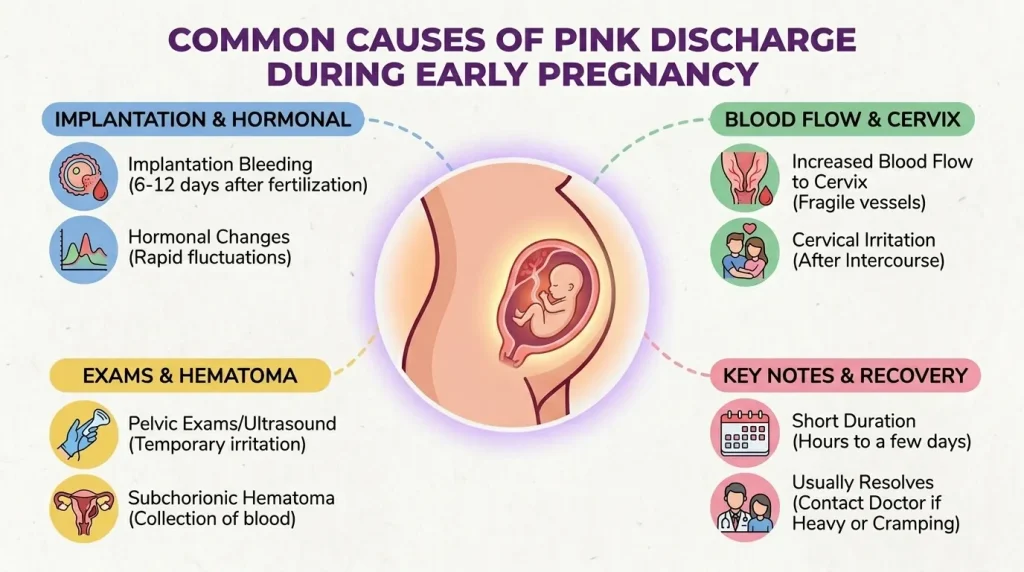
Implantation Bleeding
One of the earliest causes of pink spotting is implantation bleeding. This may occur 6 to 12 days after fertilization, when the developing embryo attaches to the lining of the uterus.
Implantation bleeding is usually much lighter than a menstrual period. It may appear as a few drops of pink or light brown discharge and often lasts only a few hours or up to two days. Some women never experience implantation bleeding at all, so its absence is completely normal.
Increased Blood Flow to the Cervix
During pregnancy, your body begins increasing blood supply to the uterus and cervix to support the developing baby. As a result, the tiny blood vessels around the cervix become more fragile and can bleed easily.
This is one of the most common reasons doctors see light spotting during the first trimester. Even minor irritation can cause a small blood vessel to break, leading to a pink stain on underwear or toilet tissue.
Cervical Irritation After Intercourse
Sex during a healthy pregnancy is generally safe unless your healthcare provider advises otherwise. However, because the cervix becomes softer and more vascular during pregnancy, intercourse may occasionally trigger light spotting afterward.
The spotting is typically painless, remains light, and settles within a day. If bleeding becomes heavier or is accompanied by persistent cramping, you should contact your healthcare provider.
Pelvic Examinations or Ultrasound
Some women notice light spotting after a pelvic examination, Pap test, or transvaginal ultrasound. These procedures may gently disturb the delicate blood vessels on the cervix, resulting in a small amount of bleeding.
This type of spotting is usually temporary and resolves without affecting the pregnancy.
Hormonal Changes
Early pregnancy is marked by rapid hormonal changes as your body transitions from relying on the corpus luteum to the developing placenta for hormone production.
During this period, minor hormonal fluctuations may occasionally contribute to light spotting. Although this can be worrying, it does not necessarily indicate that the pregnancy is at risk. Your healthcare provider may recommend additional evaluation if spotting continues or other symptoms develop.
Subchorionic Hematoma
Another relatively common cause of first-trimester bleeding is a subchorionic hematoma, a small collection of blood that forms between the pregnancy sac and the uterine wall.
While the name sounds alarming, many subchorionic hematomas are small and resolve naturally over time. They are often discovered during routine ultrasound examinations, and many women go on to have healthy pregnancies. Your doctor may recommend follow-up scans to monitor the area until it heals.
When Could Pink Discharge Be a Sign of a Problem?
Although light pink spotting is often harmless, it’s important to remember that not every episode of bleeding during pregnancy has the same cause. Healthcare providers look at the whole clinical picture, including the amount of bleeding, your pregnancy stage, and any accompanying symptoms, before determining whether further evaluation is needed.
Threatened Miscarriage
Light spotting can sometimes be the first sign of a threatened miscarriage, but it doesn’t always mean a pregnancy will be lost. In fact, many women who experience early spotting continue to have healthy pregnancies.
Bleeding becomes more concerning if it gradually becomes heavier, turns bright red, or is accompanied by increasing abdominal cramps, lower back pain, or the passage of tissue. An ultrasound and, in some cases, repeat blood tests are usually needed to assess how the pregnancy is progressing.
Ectopic Pregnancy
An ectopic pregnancy occurs when the fertilized egg implants outside the uterus, most commonly in a fallopian tube. Although uncommon, it is a medical emergency because it can lead to life-threatening internal bleeding if left untreated.
Seek immediate medical care if pink or red bleeding is accompanied by:
- Severe one-sided pelvic or abdominal pain
- Shoulder tip pain
- Dizziness or fainting
- Weakness or difficulty standing
According to the American College of Obstetricians and Gynecologists (ACOG), early diagnosis significantly improves treatment outcomes and reduces complications.
Infection or Cervical Conditions
Occasionally, spotting may be caused by vaginal infections, inflammation of the cervix (cervicitis), or a cervical polyp. These conditions often cause light bleeding after intercourse or a pelvic examination and may also produce unusual discharge, itching, burning, or an unpleasant odor.
Most infections can be safely treated during pregnancy, making early diagnosis important for both maternal and fetal health.
Pink Discharge After IVF or IUI
Women who conceive through fertility treatments often become especially anxious about spotting because every symptom feels significant. Fortunately, light pink discharge is relatively common after IVF and does not necessarily indicate a problem.
Several factors may contribute:
- Vaginal progesterone suppositories or gel can irritate the cervix.
- The embryo transfer procedure may leave the cervix temporarily sensitive.
- Implantation itself may cause very light spotting.
- Increased blood flow during early pregnancy makes cervical tissue more likely to bleed with minimal contact.
One of the most important points for IVF patients is not to stop progesterone medication unless your fertility specialist specifically advises you to do so. Missing doses without medical guidance could affect hormonal support during early pregnancy.
If spotting occurs, contact your fertility clinic for advice. In many cases, your team may simply recommend monitoring your symptoms or arranging an ultrasound if needed.
What Will Your Doctor Do?
Many women worry that spotting automatically means something is wrong. In reality, your doctor will first gather information before deciding whether additional testing is necessary.
Depending on your symptoms and how far along the pregnancy is, your evaluation may include:
- A review of your medical and pregnancy history
- A physical examination if appropriate
- A transvaginal ultrasound to confirm the location and development of the pregnancy
- Blood tests, including beta-hCG levels when indicated
- Review of progesterone treatment for patients receiving fertility care
- Testing for vaginal or cervical infections if infection is suspected
Sometimes an ultrasound performed very early in pregnancy may not provide all the answers. In these situations, your healthcare provider may recommend repeating the scan after one to two weeks to monitor normal pregnancy development.
When Should You Seek Immediate Medical Care?
Contact your healthcare provider promptly if you notice any bleeding during pregnancy. However, seek emergency medical attention immediately if you experience:
| Symptom | Why It Needs Urgent Assessment |
| Heavy bleeding similar to or heavier than a menstrual period | May indicate pregnancy complications requiring urgent evaluation |
| Severe abdominal or pelvic pain | Could suggest ectopic pregnancy or miscarriage |
| Pain affecting one side only | Possible ectopic pregnancy |
| Passing clots or tissue | May indicate pregnancy loss |
| Dizziness, fainting, or severe weakness | Could suggest significant blood loss |
| Fever or foul-smelling discharge | May indicate an infection requiring treatment |
Prompt evaluation allows doctors to identify serious conditions early while also providing reassurance when everything appears normal.
Looking After Yourself While You Wait for Medical Advice
Waiting to be assessed can feel emotionally overwhelming. Although it may not always be possible to stop spotting immediately, there are sensible steps you can take while awaiting medical advice.
- Wear a panty liner rather than a tampon so you can monitor the amount and colour of the discharge.
- Avoid inserting anything into the vagina, including tampons, unless advised by your healthcare provider.
- Stay hydrated and get adequate rest.
- Avoid strenuous exercise or heavy lifting until you’ve spoken with your doctor.
- Continue taking all prescribed pregnancy medications, including progesterone, unless your doctor tells you otherwise.
It’s also helpful to remember that repeatedly checking for bleeding every few minutes often increases anxiety without changing the situation. If possible, monitor your symptoms calmly and note any changes to discuss with your healthcare provider.
Common Myths About Pink Discharge During Pregnancy
Myth: Every episode of spotting means miscarriage.
Fact: Many healthy pregnancies involve light spotting during the first trimester.
Myth: Pink discharge always means implantation bleeding.
Fact: Implantation is only one possible explanation. Cervical changes, intercourse, examinations, infections, and other conditions may also cause spotting.
Myth: If the bleeding stops, there’s no need to tell your doctor.
Fact: Even if spotting resolves quickly, it’s still worth informing your healthcare provider so they can decide whether any follow-up is needed.
Final Thoughts
Seeing pink discharge during early pregnancy can be frightening, but it doesn’t automatically mean something is wrong. In many cases, it reflects the normal changes your body undergoes as pregnancy progresses. Paying attention to the amount of bleeding, how long it lasts, and whether it is accompanied by pain or other symptoms provides far more useful information than colour alone.
If you’re ever unsure, don’t hesitate to contact your healthcare provider. Early assessment can either identify a condition that needs treatment or provide reassurance that your pregnancy is progressing normally. At Ferty9 Fertility Center, supporting patients through these uncertain moments is an important part of early pregnancy care, ensuring you receive timely advice and appropriate evaluation whenever concerns arise.




















 No need to worry, your data is 100% safe with us!