


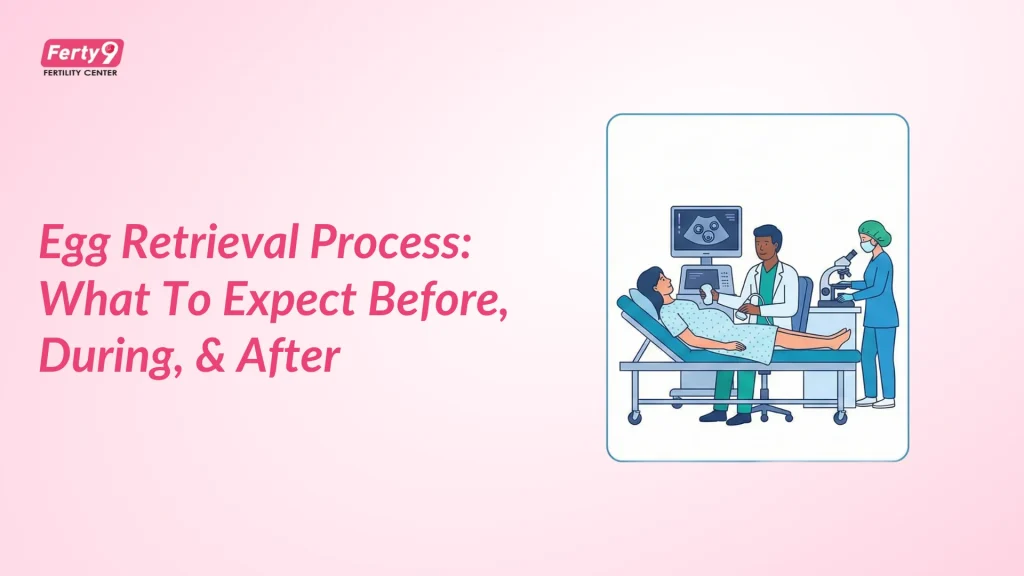
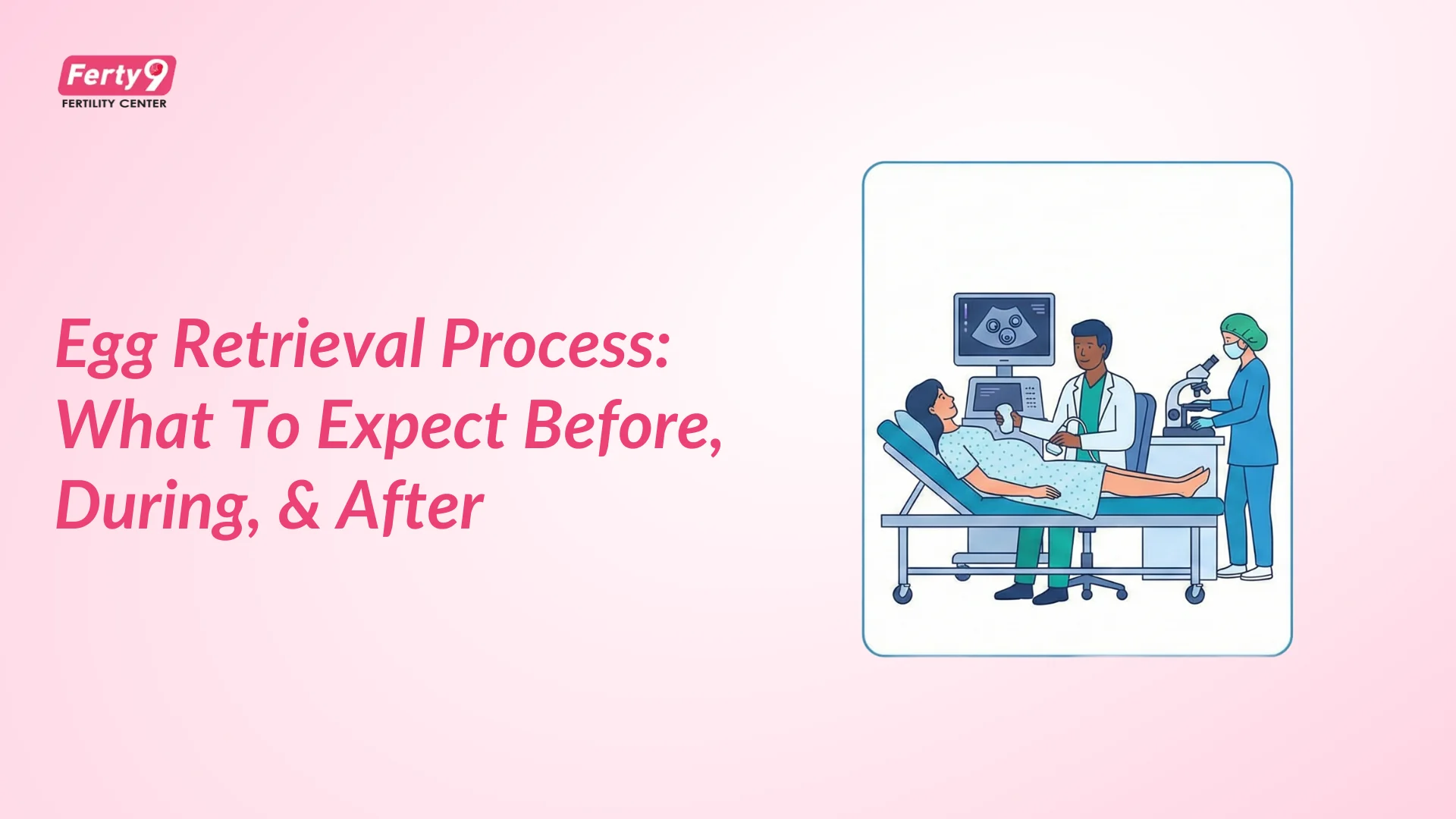
If you are undergoing IVF treatment, the Egg Retrieval Day (medically known as Ovum Pick-Up or OPU) is one of the most significant milestones in your cycle. It is the day we finally collect the eggs you have been working so hard to grow over the last two weeks!
It is completely normal to feel nervous. Many patients ask, “Is it painful?” “Will I be awake?” “How long does it take?”
At Ferty9 Fertility Center, we want you to feel calm and prepared. Here is a complete guide to what happens before, during, and after the egg retrieval process, explained in simple terms.
- Time The Trigger Shot – Take the final HCG trigger injection exactly 34 to 36 hours before egg retrieval because even a one-hour delay can affect the outcome.
- Follow Fasting Rules – Do not eat or drink for 6 to 8 hours before retrieval because the procedure is performed under sedation.
- Expect A Short Procedure – Egg retrieval is done under deep sedation using a thin needle guided by ultrasound and usually takes 15 to 20 minutes.
- Plan For Simple Recovery – Mild cramps, light spotting, sleepiness, and constipation can occur afterward. Rest for the day, stay hydrated, and return to work the next day.
- Know The Warning Signs – Contact the clinic for severe pain, heavy bleeding, fever above 101°F, severe bloating, breathing difficulty, or vomiting that does not stop.
Part 1: Before the Procedure (Preparation)
The success of the retrieval depends heavily on the final 36 hours before the surgery.
1. The “Trigger Shot” is Critical
About 34 to 36 hours before your scheduled surgery, you will take a final HCG injection (Trigger Shot).
- Why it matters: This injection matures the eggs and releases them from the follicle wall.
- Strict Timing: You must take this injection at the exact time mentioned by your nurse. Even a 1-hour delay can affect the outcome. If you miss the time, call the clinic immediately.
2. Fasting Instructions (Nil by Mouth)
Since the procedure is done under sedation (anaesthesia), your stomach must be completely empty.
- The Rule: Do not eat or drink anything (including water, tea, or coffee) for 6 to 8 hours before the procedure.
- Why? Having food in your stomach during anaesthesia can cause vomiting or aspiration, which is dangerous.
3. What to Wear and Bring
- Wear loose, comfortable clothes like a kurta or loose trousers.
- Remove all jewellery, contact lenses, and nail polish (so we can monitor your oxygen levels easily).
- Bring your ID proof and your husband (for sperm collection and to drive you home).
- Skip the Scents: Please do not wear any perfume, deodorant, strong lotions, or talcum powder on the morning of the surgery.
- Why? Eggs are microscopic and extremely sensitive to smells and chemicals (VOCs). We keep our Operation Theatre and Lab air purely sterile to protect your eggs.
Part 2: During the Procedure (The OPU)
“Is egg retrieval painful?” This is the #1 question. The answer is: No, you will not feel pain.
At Ferty9, we perform this procedure under Deep Sedation (IV Anaesthesia). You will be asleep and unaware of the procedure. It is not like a major surgery with cuts or stitches.
Step-by-Step in the Operation Theatre (OT):
- Preparation: You will change into a hospital gown and meet the anaesthetist. An IV line (cannula) will be placed in your hand.
- Sedation: You will be given medication through the IV. Within seconds, you will drift into a deep sleep.
- The Collection: The doctor uses a transvaginal ultrasound probe (the same one used for your scans) with a thin needle guide.
- Aspiration: The needle gently passes through the vaginal wall into the ovary. It suctions the fluid from each follicle, which contains the egg.
- Handover: The test tubes with the fluid are immediately passed to the embryologist in the lab next door, who checks for eggs under a microscope.
Duration: The entire process takes only 15 to 20 minutes.
Part 3: After the Procedure (Recovery)
Immediate Recovery (In the Clinic)
You will wake up in the recovery room about 15-20 minutes after the procedure ends.
- You might feel groggy or sleepy (like a hangover feeling).
- The nurse will monitor your BP and pulse.
- Once you are fully awake, we will give you a light snack (usually tea/juice and biscuits).
- Going Home: You will be discharged after 2 to 3 hours of observation.
Recovery at Home
- Rest: Take the day off work. Relax in bed or on the sofa. You can return to work the next day.
- Cramping: You may feel mild lower abdominal pain, similar to period cramps. Your doctor will prescribe a basic painkiller (like Paracetamol) for this.
- Spotting: Light vaginal bleeding or spotting is normal. Use a sanitary pad, not a tampon.
- Watch Out for Constipation: It is very common to feel constipated for a few days after egg retrieval. This happens due to the anaesthesia, pain medication, and high progesterone levels slowing down your digestion.
- Natural Remedy: Drink warm water or mild Isabgol (Psyllium husk) at night if needed. Eat fibre-rich fruits like papaya or figs (anjeer) to keep movements smooth.
- Heat Therapy: You can use a hot water bag or a heating pad on your lower back or tummy to relieve cramping. Just ensure it is not too hot, as we want to avoid raising your core body temperature excessively if you are planning a fresh transfer soon.
Diet Tips for Recovery
Your ovaries are still large and swollen from the stimulation.
- Eat Light: Stick to home-cooked, easy-to-digest Indian meals like Khichdi, Idli, Curd Rice, or clear soups. Avoid spicy or oily biryanis that can cause gas/bloating.
- Stay Hydrated: Drink plenty of water, coconut water, or buttermilk (chaas) to flush out the anaesthesia and reduce bloating.
When to Call the Doctor? (Red Flags)
While recovery is usually smooth, contact Ferty9 immediately if you experience:
- Severe pain that painkillers don’t fix.
- Heavy bleeding (soaking a pad in an hour).
- Fever over 101°F.
- Severe bloating or difficulty breathing (signs of OHSS).
- Vomiting that won’t stop.
Part 4: What Happens Next? (The Lab Report)
Once you go home, our embryologists get to work. You won’t need to visit the clinic, but you will receive crucial phone calls over the next few days.
- Day 0 (Same Day): We will tell you exactly how many eggs were collected before you leave the clinic.
- Day 1 (Fertilization Report): We call you to tell you how many eggs were mature and successfully fertilised by the sperm.
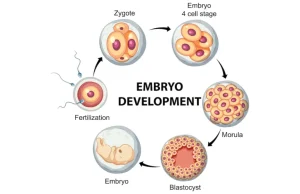
- Day 5 (Blastocyst Report): We wait to see how many fertilized eggs grow into strong “Blastocyst” embryos. This is the final count of embryos available for freezing or transfer.
Summary
Egg retrieval is a short, safe, and painless milestone in your IVF journey. By following the fasting rules and resting well afterwards, you set the stage for the next exciting step—embryo transfer! Trust your body, and trust the team at Ferty9. We are with you at every step.















 No need to worry, your data is 100% safe with us!