


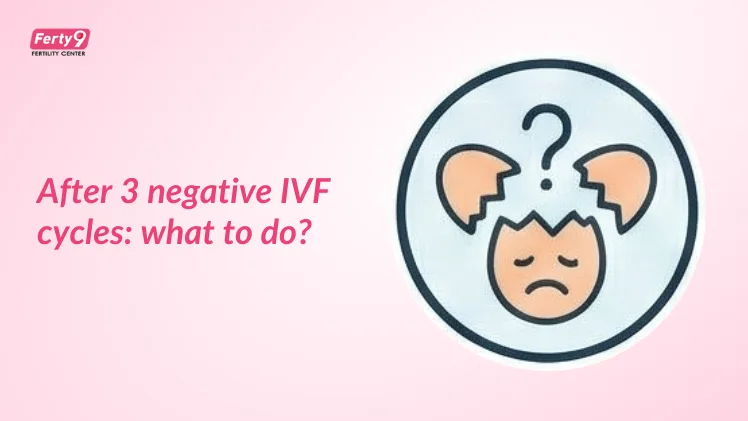
Seeing a negative pregnancy test after one IVF cycle is heartbreaking. Seeing it after the second one is devastating. But facing a third failed IVF cycle can feel like hitting a wall. You might be asking yourself: “Is my body broken?” “Should I stop trying?”, or “Is it time to give up?”
At Ferty9 Fertility Center, we want you to know two things immediately:
- You are not alone. Many couples face multiple failures before finally holding their baby.
- This is not the end. Three failures do not mean you cannot get pregnant; it often means we haven’t found the specific missing piece of the puzzle yet.
This guide is designed to help you pause, breathe, and understand the medical steps we can take to turn “Repeated Implantation Failure” into a success story.
Understanding the Emotional Impact of Repeated IVF Failure
Why 3 Failed Cycles Feel Like a Breaking Point
In the world of fertility, three is often considered a medical threshold. Doctors call this “Recurrent Implantation Failure” (RIF). It is the point where hope turns into fear. You have invested time, money, and your body’s energy, and to have no result can feel like a personal defeat.
It’s Not Just Physical—The Mental Toll Explained
The grief of a failed IVF cycle is invisible to the world but heavy for the couple. It is normal to feel anger and jealousy towards pregnant friends, or a sense of detachment. This “fertility burnout” is real, and acknowledging it is the first step to healing.
Is 3 Failed IVF Cycles Common?
IVF Statistics That Most Clinics Don’t Highlight
Here is a fact that might comfort you: The average success rate for one IVF cycle ranges from 30% to 50%. This means that mathematically, many healthy couples need 2 to 3 cycles to conceive. It is not necessarily a sign that something is wrong with you; it is often just a matter of probability.
When Failure Doesn’t Mean the End
Studies show that the cumulative success rate (the chance of pregnancy over multiple tries) continues to rise up to the 6th cycle. While we don’t want you to endure that many, knowing this proves that persistence often pays off.
First Things First: Pause and Review
Why Rushing Into a Fourth Cycle Can Backfire
The biggest mistake couples make is jumping immediately into the next cycle out of panic – Stop. If the standard protocol didn’t work three times, doing the exact same thing a fourth time is unlikely to yield a different result.
The Power of a Strategic Break
Take a break of 1–2 months. This allows:
- Your ovaries recover from stimulation.
- Your hormones reset.
- Your doctor to review your case with a fresh perspective.
Detailed IVF Cycle Review With Your Specialist
Egg Quality Assessment
Was the issue with the egg?
- If you had poor fertilization or embryos that stopped growing by Day 3, it points to Egg Quality issues.
- In older women (35+), the eggs may look normal but lack the energy (mitochondria) to divide properly.
Sperm Health Re-evaluation
We often focus so much on the woman that we forget the man.
- A standard semen analysis isn’t enough. We might recommend a DNA Fragmentation Index (DFI) test. High DNA damage in sperm can lead to excellent fertilization but early embryo failure.
Embryo Development and Grading
Day 3 vs Day 5 Embryo Transfers
If your previous cycles used Day 3 embryos, we might switch to Day 5 (Blastocyst) Transfer.
- Why? Only the strongest embryos survive to Day 5. Transferring a Blastocyst acts as a natural filter, ensuring we only use the best embryos with the highest implantation potential.
Genetic Testing-Is PGT-A the Missing Piece?
What PGT-A Really Tests
Sometimes, an embryo looks “perfect” under a microscope (Grade A) but is genetically abnormal inside (Aneuploid). PGT-A (Preimplantation Genetic Testing for Aneuploidy) involves taking a few cells from the embryo to check if it has the correct number of chromosomes.
Who Benefits Most From Genetic Screening
- Women over 35.
- Couples with Recurrent Pregnancy Loss.
- Cases where good-quality embryos fail to implant repeatedly.
- Finding a genetically normal embryo can increase success rates to over 60-70%.
Uterine and Endometrial Factors Often Missed
Endometrial Receptivity Analysis (ERA)
Are we transferring the embryo at the wrong time? Every woman has a specific “Window of Implantation.” For some, it opens on Day 19; for others, Day 21. An ERA Test (biopsy of the lining) tells us exactly when your uterus is ready to accept the embryo.
Hidden Issues Like Polyps, Fibroids, and Adhesions
A standard ultrasound might miss small issues.
- Hysteroscopy: We put a tiny camera inside the uterus to look for small polyps, scar tissue, or a septum that could be pushing the embryo away. Fixing these can be a game-changer.
Immune and Blood Clotting Disorders
When the Body Attacks the Embryo
Sometimes, a woman’s immune system is “too active” and mistakes the embryo for a foreign invader.
- Reproductive Immunology: Conditions like high Natural Killer (NK) cells can prevent implantation.
Tests Worth Discussing With Your Doctor
- APLA Panel: Checks for blood clotting disorders (Antiphospholipid Syndrome) that cut off blood supply to the baby.
- Treatment: Simple blood thinners (like Aspirin or Heparin) can often solve this.
Hormonal Imbalances That Affect Implantation
Thyroid, Prolactin, and Insulin Resistance
- TSH: Must be below 2.5 for conception.
- Prolactin: High levels interfere with the lining.
- Insulin: Hidden insulin resistance (common in PCOS) creates a toxic environment for the embryo.
Luteal Phase Defects Explained Simply
If your body doesn’t produce enough Progesterone after the transfer, the lining sheds before the embryo can stick. We may need to increase your progesterone support (injections/gel).
Lifestyle Factors That Quietly Sabotage IVF
Weight, Diet, and Stress
- BMI: Being significantly over or underweight affects success.
- Indian Diet: Reduce high-carb foods (white rice, sweets) and increase protein.
- Sleep: Melatonin affects egg quality. Aim for 7-8 hours in total darkness.
Should You Change Your IVF Clinic or Doctor?
Signs It’s Time for a Second Opinion
Loyalty is good, but results matter more. Consider a second opinion if:
- Your doctor cannot explain why the cycles failed.
- The clinic does not offer advanced technology like Blastocyst culture, PGT-A, or ERA.
- You feel like just a number, not a patient.
What Top Fertility Clinics Do Differently
At Ferty9, we have a “Failed Cycle Board” where senior doctors review difficult cases together. A fresh pair of eyes can often spot something that was missed.
Advanced IVF Options After Repeated Failure
Donor Eggs or Donor Sperm
If egg or sperm quality is the absolute barrier, using Donor Gametes drastically improves success rates (up to 70-80%). This is a hard decision, but it offers a very high chance of carrying a baby.
Embryo Donation
Adopting a healthy embryo from another couple is another beautiful, cost-effective path to pregnancy.
Considering a Natural or Modified IVF Approach
Mild Stimulation Cycles
Sometimes, “less is more.” High doses of drugs can reduce egg quality in some women. A Natural Cycle IVF or Mild Stimulation aims for fewer, but higher-quality eggs.
Frozen Embryo Transfers for Better Outcomes
If you have been doing fresh transfers, switching to Frozen Embryo Transfer (FET) allows your body to recover from the drugs, creating a calmer, more receptive environment for the baby.
Emotional Healing After IVF Failure
Grief, Guilt, and Letting Go of Blame
Please stop saying, “It’s my fault.” It isn’t. Infertility is a medical condition, not a moral failure.
Counselling, Support Groups, and Therapy
Talk to a fertility counsellor. Sometimes, just having a safe space to cry without judgment helps you find the strength to try again.
When to Stop IVF—and That’s Okay
Redefining Success Beyond Pregnancy
There is courage in trying, and there is courage in stopping. If the financial, physical, or emotional cost becomes too high, choosing to stop medical treatment is a valid and brave choice. It allows you to reclaim your life.
Alternative Paths to Parenthood
Adoption
There are millions of children waiting for love. Adoption is a beautiful way to build a family when biological paths close.
Living Child-Free—A Valid Choice
Some couples find peace in choosing a child-free life, focusing on their partnership, career, and other passions.
Summary
Three failed IVF cycles are a painful milestone, but it is rarely the end of the road. It is a signal to pause, investigate, and change the strategy. Whether it means genetic testing, a hysteroscopy, or switching to donor eggs, there are still many doors open. Ready for a Fresh Perspective? Bring your previous reports to Ferty9 Fertility Center. Our “Recurrent Failure Panel” will review your history deeply to find the answers you deserve.













 No need to worry, your data is 100% safe with us!