Starting your fertility journey often begins with one important question “what exactly is IVF, and how can it help you?”In Vitro Fertilization (IVF), commonly known as test tube baby treatment is a type of assisted reproductive technology (ART) in which eggs are collected from the ovaries and fertilized with sperm in a laboratory. The resulting embryo is then transferred into the uterus to achieve pregnancy. A typical IVF cycle takes about 4 to 6 weeks and enables specialists to monitor each stage closely, improving success rates in cases of medical, age-related, or unexplained infertility.
Dr. Sneha explains about IVF Treatment
A Brief History of IVF
IVF has come a long way since the birth of the first test tube baby (first IVF baby) in 1978. What was once considered experimental is now a well-established and widely practiced medical procedure.
Advancements in embryology, laboratory techniques, and genetic testing have made IVF more precise and effective over time. Today, millions of babies worldwide have been born through IVF, making it a trusted solution for infertility.
Why Is IVF Treatment Recommended?
Doctors recommend IVF when natural conception or basic treatments like medication or IUI fail, or when specific medical conditions reduce the chances of pregnancy.
It is often recommended when:
Pregnancy has not occurred despite trying for a long time
In simple terms, IVF is advised when a more medically guided approach can improve outcomes.
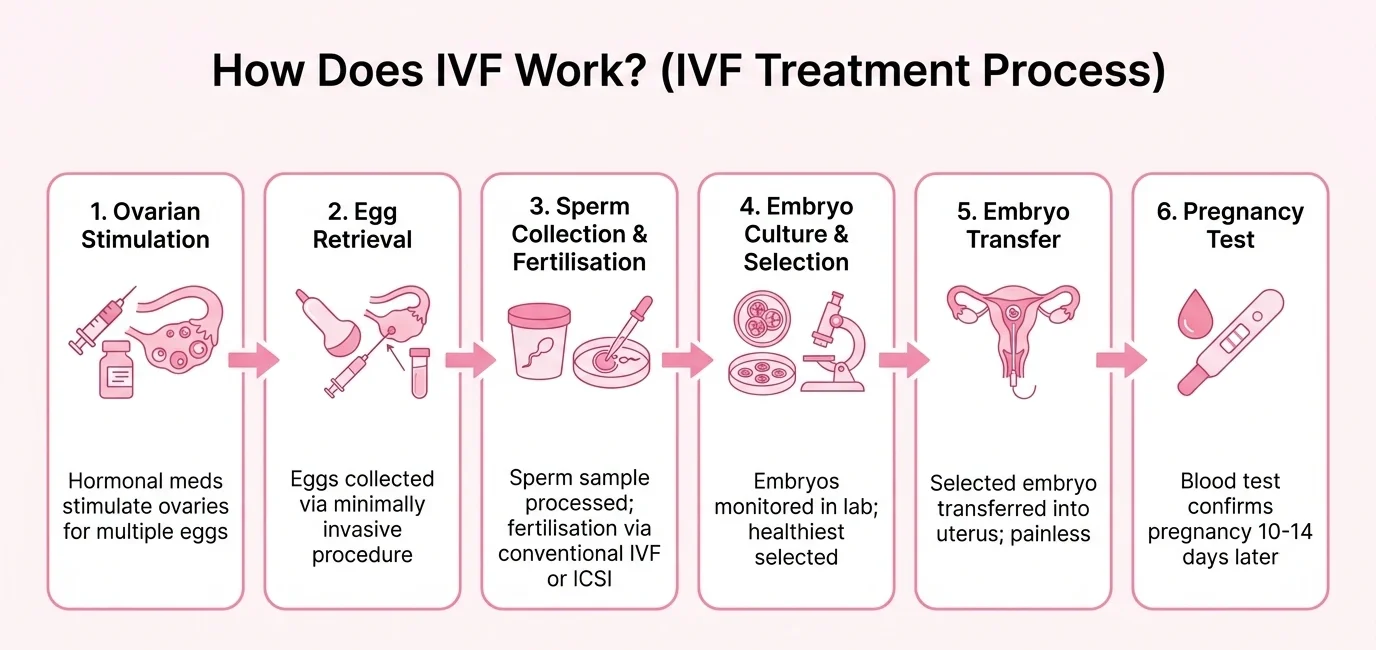
IVF process showing ovarian stimulation, egg retrieval, fertilisation, embryo culture, transfer, and pregnancy testing in sequence.
How Does IVF Work? (IVF Treatment Process)
IVF involves a step-by-step process that supports fertilisation and implantation.
Here is how a typical IVF cycle works:
1. Ovarian Stimulation
Hormonal medications are used to stimulate the ovaries to produce multiple mature eggs instead of just one. This increases the chances of successful fertilisation.
2. Egg Retrieval
Once the eggs are mature, they are collected through a minimally invasive procedure performed under ultrasound guidance and mild sedation.
3. Sperm Collection & Fertilisation
A semen sample is collected and processed to select the healthiest sperm. Fertilisation is carried out either through conventional IVF or ICSI, depending on the clinical situation.
4. Embryo Culture & Selection
The fertilised eggs are observed in the laboratory for a few days. Embryologists monitor their development and select the healthiest embryos.
5. Embryo Transfer
A selected embryo is transferred into the uterus using a thin catheter. This is a simple and painless procedure.
6. Pregnancy Test
A blood test is done about 10 to 14 days after the transfer to confirm pregnancy.
IVF Timeline: How Long Does It Take?
A typical IVF cycle takes 3 to 5 weeks, including ovarian stimulation, egg retrieval, fertilisation, embryo development, and transfer. After transfer, patients wait 10–14 days for pregnancy confirmation.
IVF Success Rates: What Are the Chances?
IVF success rates are strongly influenced by age, as egg quality naturally declines over time.
Here’s a general age-wise estimate:
Under 30 years: ~65%–70%
30 to 35 years: ~55%–65%
35 to 40 years: ~40%–50%
Above 40 years: ~25%–35%
Other factors such as sperm health, uterine condition, embryo quality, and lifestyle also affect outcomes.
Note: These are general estimates, and results can vary from person to person. A fertility specialist can provide a more personalised assessment based on your condition.
Types of IVF Treatments
IVF includes different techniques based on medical needs. Conventional IVF allows fertilisation to occur naturally in the lab, while ICSI involves injecting a single sperm directly into the egg. Other options include frozen embryo transfer (FET), minimal stimulation IVF, and donor-assisted IVF. The approach is selected based on the underlying condition and medical evaluation.
Role of Injections in IVF
Doctors use hormonal injections to stimulate the ovaries and control ovulation timing. These medications help produce multiple eggs, increasing the chances of successful fertilisation. These injections are safe, used for a short duration, and monitored throughout the cycle.
Who Needs IVF Treatment?
IVF is one of the most effective options for individuals and couples facing specific fertility challenges. It is especially helpful when medical conditions make natural conception difficult.
Here are some common situations where IVF may be advised:
Blocked or Damaged Fallopian Tubes: Prevents natural fertilisation, which IVF can bypass.
Polycystic Ovary Syndrome (PCOS): Affects ovulation and hormonal balance, making conception difficult.
Endometriosis: Impacts egg quality and the uterine environment.
Male Factor Infertility: Includes low sperm count or poor motility, which can be managed using IVF with ICSI.
Uterine Conditions: Such as fibroids or abnormalities that affect implantation.
Unexplained Infertility: Where no clear cause is identified despite testing.
Genetic Concerns: Where embryo screening is needed to prevent inherited conditions.
How to Prepare Your Body for IVF?
You can improve IVF outcomes by making simple lifestyle changes:
Eat a balanced, nutritious diet
Stay physically active, but avoid over-exertion
Avoid smoking, alcohol, and excess caffeine
Manage stress through relaxation techniques
Follow your doctor’s advice on supplements and medications
These steps help create a healthier environment for treatment and pregnancy.
Benefits of IVF (In Vitro Fertilisation)
Higher success rates compared to many other treatments
Option for genetic testing to avoid inherited conditions
Ability to freeze embryos for future use
Helps overcome both male and female infertility issues
Allows better planning of pregnancy timing
Useful in age-related fertility decline
Supports donor and single-parent options
Risks and Possible Complications
Possible risks include ovarian hyperstimulation (OHSS), multiple pregnancy, emotional stress, and cycle cancellation. These risks are generally manageable with proper monitoring and medical care.
Precautions After IVF
After embryo transfer, it is important to follow medical advice carefully.
Avoid heavy physical activity
Follow prescribed medications
Maintain a healthy routine
Regular follow-ups help support implantation and early pregnancy.
IVF vs IUI: How is IVF Different from IUI?
Feature
IUI (Intrauterine Insemination)
IVF (In Vitro Fertilization)
Fertilization Location
Inside the woman’s body (in vivo).
Outside the woman’s body (in vitro), in a lab.
Process
Washed and concentrated sperm is placed directly into the uterus around the time of ovulation to give it a “head start.”
Eggs are retrieved from the ovaries, fertilized in the lab to create embryos, and then an embryo is transferred into the uterus.
Control Level
Less controlled. Relies on the sperm being able to find and fertilize the egg inside the fallopian tube on its own.
Highly controlled. Every step from egg maturation to fertilization and early embryo growth is managed by specialists.
Best Suited For
Mild male factor infertility, cervical issues, or unexplained infertility where the fallopian tubes are open.
Blocked fallopian tubes, severe male factor infertility, diminished ovarian reserve, endometriosis, and when IUI has failed.
Dr. Tejaswini explaining about difference between IUI and IVF
Is IVF the Right Option for You?
IVF may be the right option if you have been trying to conceive without success or have specific fertility conditions. A consultation with a fertility specialist can help determine the most suitable treatment plan based on your individual needs.
Final Thoughts
In vitro fertilization (IVF) is a fertility treatment where an egg is fertilized with sperm outside the body in a laboratory. The resulting embryo is then transferred to the uterus to help achieve pregnancy. IVF is commonly used when couples face infertility or difficulty conceiving naturally. IVF has helped millions of individuals and couples achieve parenthood when other options were not successful. While the IVF process may feel overwhelming at first, the right medical guidance can make it easier to navigate. Understanding each step allows you to make informed decisions and move forward with confidence.
*Disclaimer The information on this website, including IVF success rates, costs, and treatment details, is for general informational purposes only. Success rates and costs are indicative and may vary based on individual factors such as age, medical condition, diagnosis, treatment type, and centre location, and do not guarantee outcomes or final charges. All treatments and recommendations are based on individual medical evaluation, and this content should not be considered medical advice. For accurate and personalised information, please consult a fertility specialist at Ferty9.
Have more Queries about IVF? Book Free First Consultation with our Fertility Experts Today!






 No need to worry, your data is 100% safe with us!