


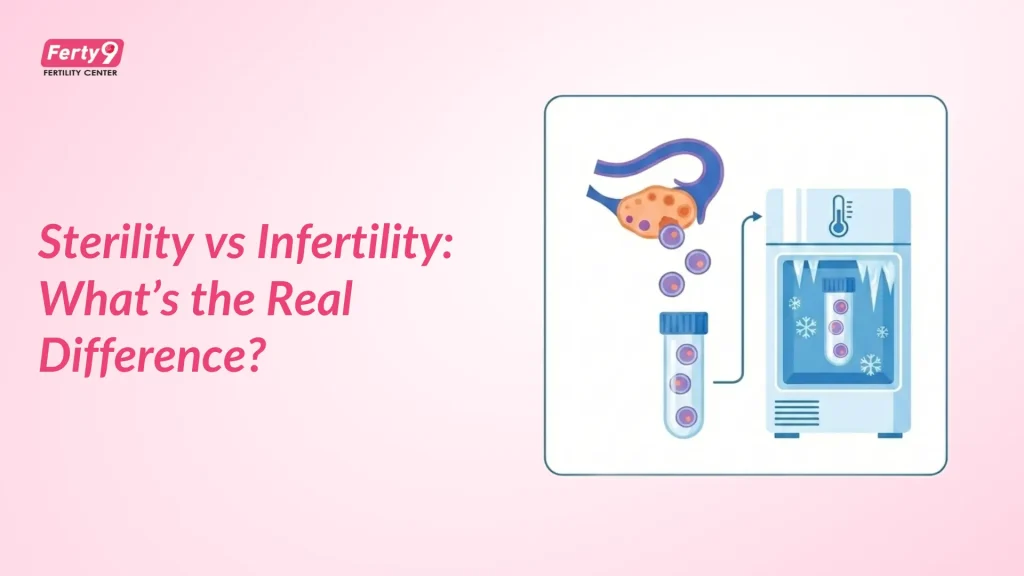
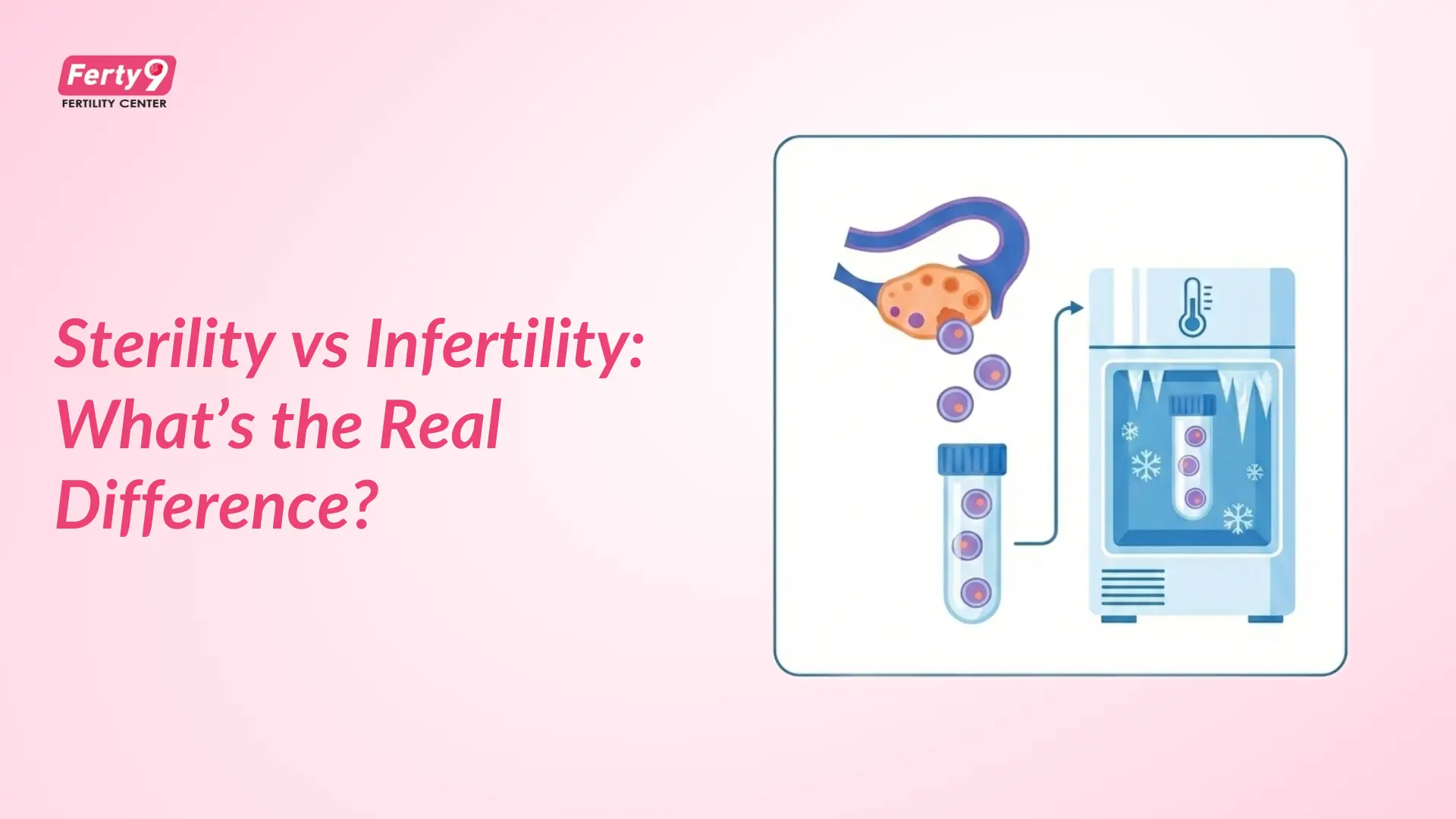
When a couple struggles to have a baby, you often hear words thrown around loosely: “Are they infertile?” or “Is he sterile?”
In everyday conversation, people use Infertility and Sterility to mean the same thing—the inability to have a child. But medically, these are two very different conditions with very different treatments.
Understanding which category you fall into is the first step toward finding a solution. At Ferty9 Fertility Center, we want to clear the confusion. Here is a simple breakdown of the difference between being infertile and being sterile, and what it means for your dream of becoming a parent.
What is Infertility? (The “Delay”)
Infertility does not mean you cannot have children. It simply means your reproductive system is facing a roadblock that is delaying pregnancy.
The Medical Definition:
You are considered infertile if you have been trying to conceive naturally (having regular unprotected sex) for 12 months without success (or 6 months if the female partner is over 35).
Key Features:
- It is often temporary. With the right medication or procedure, the roadblock can be removed.
- You still produce eggs and sperm. The quality or quantity might be low, but the potential is there.
- Treatment success is high. Many infertile couples conceive with simple treatments like IUI or IVF.
Common Causes in India:
- Women: PCOS (Polycystic Ovaries), blocked fallopian tubes, hormonal imbalances.
- Men: Low sperm count (Oligospermia), slow sperm movement (motility issues).
What is Sterility? (The “Absence”)
Sterility is a more absolute condition. It means an individual is physically unable to produce a biological child naturally because the essential tools—sperm, eggs, or a uterus—are missing or completely non-functional.
The Medical Definition:
Sterility is the complete inability to conceive due to the absence of gametes (sperm/eggs) or the reproductive organs required for pregnancy.
Key Features:
- It is usually permanent (unless treated with advanced surgical or donor options).
- Natural conception is impossible. No amount of “trying” naturally will result in a baby.
Common Causes:
- Surgical Sterility: If you have had a Tubectomy (tubes tied) or Vasectomy (family planning operation).
- Congenital Issues: Being born without a uterus (MRKH syndrome) or testes.
- Medical Treatments: Cancer treatments like chemotherapy can sometimes cause permanent sterility by destroying all eggs or sperm.
- Azoospermia (Non-Obstructive): Where the testicles produce zero sperm.
Types of Infertility and Sterility
Did you know you can face these issues even if you already have a healthy child? Doctors classify patients into two categories:
Primary vs. Secondary
- Primary Infertility/Sterility: This refers to couples who have never been able to conceive a pregnancy.
- Secondary Infertility/Sterility: This is when a couple has had one or more children in the past but is now unable to conceive again.
- Example of Secondary Sterility: A woman who had a Tubectomy (Family Planning Operation) after her second child.
- Example of Secondary Infertility: A woman who developed PCOD or Thyroid issues after her first delivery and cannot conceive a second time.
At a Glance: Infertility vs. Sterility
| Feature | Infertility | Sterility |
| Basic Meaning | Difficulty in conceiving. | Inability to conceive naturally. |
| Sperm/Egg Status | Present, but may be low quality/count. | Completely absent or blocked. |
| Natural Pregnancy | Possible (though rare/difficult). | Impossible. |
| Primary Solution | Medication, IUI, or IVF. | Donor Program, Surrogacy, or Surgery. |
How Do We Diagnose the Difference?
You cannot tell if you are sterile or infertile just by symptoms. At Ferty9, we use advanced diagnostics to find the root cause:
- Semen Analysis (For Men):
- Low count/motility = Infertility.
- Zero sperm (Azoospermia) = Potential Sterility (requires further testing).
- Hysterosalpingogram (HSG): A specialized X-ray to check if the fallopian tubes are open (Fertile) or blocked (infertile).
- AMH Test: Measures ovarian reserve. Extremely low AMH might indicate near-menopause (Sterility), while moderate levels indicate Infertility.
- Karyotyping (Genetic Testing): Checks for genetic conditions like Klinefelter syndrome (in men) or Turner syndrome (in women) that cause permanent sterility.
Can “Sterile” Couples Still Become Parents?
Yes! This is the most important part.
Decades ago, a diagnosis of sterility meant the end of the road. Today, thanks to advanced fertility treatments at clinics like Ferty9, even sterile couples can experience the joy of parenthood.
Here is how we treat it:
1. For Surgical Sterility (Tubectomy/Vasectomy)
If you had a family planning operation years ago but now want another child (perhaps after remarriage), you are surgically sterile.
- Solution: We can perform a Reversal Surgery to untie the tubes/vas deferens. Alternatively, we can use IVF to bypass the tubes entirely.
2. For “No Sperm” (Azoospermia)
If a man is sterile because there is no sperm in his semen:
- Solution: We use TESA/PESA (surgical sperm retrieval). Often, sperm is still being made inside the testicles, just not coming out. We pick it directly from the source and use it for ICSI.
- Donor Sperm: If absolutely no sperm is produced, donor sperm is a highly successful option.
3. For Premature Menopause or Poor Egg Quality
If a woman is sterile because her ovaries have stopped releasing eggs (menopause):
- Solution: Donor Eggs or Embryo Donation. We use eggs from a healthy young donor, fertilize them with your husband’s sperm, and place the embryo in your womb. You carry the pregnancy and deliver the baby yourself.
4. For Absent Uterus
If a woman cannot carry a child:
- Solution: Surrogacy. Your egg and your husband’s sperm create an embryo, which is carried by a gestational carrier.
Myths vs. Facts: Clearing the Confusion
| Myth | Fact |
| “Sterility is always a woman’s problem.” | False. Men can be sterile too (Azoospermia or absence of tubes). In fact, 30-40% of fertility issues are male-related. |
| “If you have regular periods, you cannot be infertile.” | False. You can have regular periods but still have blocked tubes or poor egg quality, which causes infertility. |
| “Sterility is always permanent.” | Not Always. Surgical sterility (like a Vasectomy or Tubectomy) can often be reversed by skilled microsurgeons at Ferty9. |
| “Infertility is just stress.” | False. While stress affects health, infertility is a medical condition caused by physical factors like hormones, tubes, or sperm quality. |
Summary
- Infertility is a hurdle; Sterility is a wall.
- Infertility treatments help you jump over the hurdle.
- Sterility treatments help you find a door through the wall (using Donors or Surrogacy).
Don’t let the terminology scare you. Whether you are facing infertility or sterility, modern science has a way to help you build your family.
Not sure which category you fall into?
A simple consultation and scan can give you the answer. Book an appointment with Ferty9 Fertility Centre today to understand your body better.












 No need to worry, your data is 100% safe with us!