Intrauterine Insemination, commonly known as IUI, is often the first fertility treatment recommended by doctors for couples having trouble conceiving. It is a simple, safe, and less invasive procedure designed to give sperm a “head start” in the race to fertilize an egg.
In a natural pregnancy, sperm must travel from the vagina, swim through the cervix, and move up into the uterus to reach the fallopian tubes where the egg is waiting. Only a small fraction of sperm survive this long journey.
In IUI, we bypass the difficult first leg of this journey. Highly concentrated, healthy sperm is placed directly inside the woman’s uterus using a thin, flexible tube. This puts the sperm much closer to the egg, significantly increasing the chances of them meeting and successful fertilization taking place.
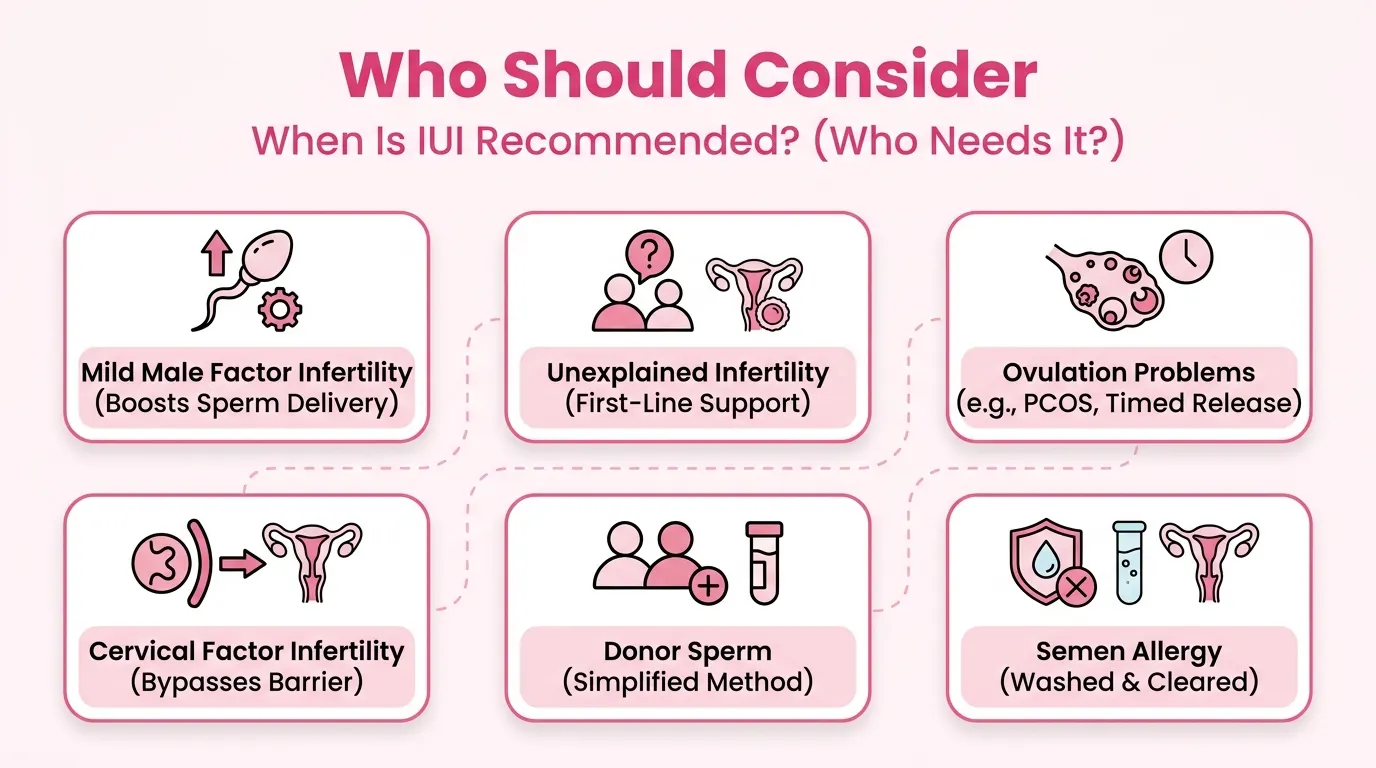
When Is IUI Recommended? (Who Needs It?)
IUI is not a solution for every fertility problem, but it is an excellent option for specific conditions. At Ferty9, we typically recommend IUI in the following situations:
Mild Male Factor Infertility
If the male partner has a slightly low sperm count or sperm that doesn’t move very well (low motility), IUI can help. The laboratory preparation concentrates the healthiest sperm, and placing them directly in the uterus overcomes the issue of them being “weak swimmers.”
Unexplained Infertility
This is one of the most common reasons for IUI. It refers to couples who have normal test results (normal ovulation, open tubes, and normal sperm) but still cannot conceive. IUI, often combined with ovulation-inducing medication, is the standard first-line treatment here.
Ovulation Problems (Like PCOS)
Women with Polycystic Ovary Syndrome (PCOS) often do not ovulate regularly. We can use medication to stimulate the release of an egg and time the IUI procedure perfectly to coincide with ovulation.
Cervical Factor Infertility
The cervix produces mucus that helps sperm travel during ovulation. However, if this mucus is too thick or “hostile” (killing the sperm before they can swim through), it acts as a barrier. IUI bypasses the cervix entirely, depositing sperm directly into the uterus.
Donor Sperm
For couples who need to use donor sperm (due to severe male infertility or absence of sperm), IUI is the most common and simplest method used to achieve pregnancy.
Semen Allergy
Though very rare, some women have an allergy to proteins in their partner’s semen. IUI is effective here because the sperm is “washed” in the lab before insemination, removing the proteins that cause the reaction.
Who Should Consider IUI Treatmen.
Who is Not a Good Candidate for IUI?
IUI requires certain biological functions to work effectively. It is generally not recommended if:
Blocked Fallopian Tubes: Since fertilization happens naturally inside the fallopian tubes in IUI, at least one tube must be open. If both are blocked, the sperm and egg cannot meet, and IVF is required.
Severe Male Infertility: If the sperm count is extremely low or poor quality, IUI is unlikely to work.
Severe Endometriosis: Extensive scarring from endometriosis can affect the egg’s ability to enter the tube.
Advanced Maternal Age: For women over 40, the egg quality may be lower, and moving directly to IVF might offer a better success rate in a shorter time.
IUI vs. IVF: What Is the Difference?
Many patients confuse IUI with IVF. Here is the simple difference:
IUI (Intrauterine Insemination): Fertilization happens inside the woman’s body. We simply place the sperm inside the uterus, and nature takes over from there. It is simpler and less invasive.
IVF (In Vitro Fertilization): Fertilization happens outside the body. We remove eggs from the ovaries and mix them with sperm in a laboratory dish. Once an embryo forms, we place it back into the uterus. It is more complex but has higher success rates for difficult cases.
IUI is a popular choice in India because it bridges the gap between natural trying and complex treatments like IVF.
Less Invasive: The actual procedure is quick (usually a few minutes) and does not require surgery or anesthesia. It feels similar to a routine Pap smear test.
Cost-Effective: Compared to IVF, IUI is significantly more affordable. It allows couples to attempt medical intervention without a heavy financial burden initially.
Natural Cycle: IUI works with your body’s natural reproductive system. Fertilization occurs naturally within the fallopian tubes.
Lower Medication Dosage: While some women take medication to boost egg production for IUI, the doses are generally much lower than those required for IVF.
Risks and Side Effects
IUI is considered a very safe procedure, but like any medical treatment, there are minor risks to be aware of:
Multiple Pregnancies: If fertility medication is used to stimulate ovulation, there is a chance that more than one egg will be released. This increases the risk of conceiving twins or triplets. Your doctor at Ferty9 will monitor you closely with ultrasounds to minimize this risk.
Ovarian Hyperstimulation Syndrome (OHSS): Ideally, the ovaries can become swollen and painful due to the medication. This is usually mild but requires medical attention.
Infection: There is a tiny risk (less than 1%) of developing an infection after the procedure.
Spotting: You may notice very light spotting (bleeding) immediately after the procedure due to the catheter placement, which is normal and usually stops quickly.
Is IUI Painful?
Most women report that IUI is painless. You might feel a mild cramping sensation or slight pressure when the thin catheter is inserted through the cervix, similar to menstrual cramps. This discomfort typically passes within minutes. No anesthesia or painkillers are usually needed, and you can return to your daily activities almost immediately after the procedure.
Preparing for IUI
To get the best results from your IUI cycle, we recommend a few simple lifestyle adjustments:
Healthy Diet: Focus on a balanced Indian diet rich in antioxidants, fresh fruits, and vegetables.
Stress Management: High stress can affect hormones. Practices like yoga or meditation can be helpful.
Avoid Smoking and Alcohol: Both partners should avoid these as they can negatively impact egg and sperm quality.
Men: The male partner may be asked to abstain from ejaculation for 2-3 days before the procedure to ensure the sperm count is optimal on the day of IUI.
Summary
IUI acts as a helpful nudge to nature. It places the sperm exactly where they need to be, at exactly the right time. For many couples facing mild fertility challenges, this simple, affordable, and effective treatment is the key that unlocks the door to parenthood. If you have been trying to conceive for over a year without success, consult with our specialists to see if IUI is the right path for you.
*Disclaimer The information on this website, including IUI success rates, costs, and treatment details, is for general informational purposes only. Success rates and costs may vary based on individual factors such as age, fertility condition, diagnosis, treatment plan, and centre location, and do not guarantee outcomes or final charges. This content should not be considered medical advice. For accurate and personalised guidance, please consult a fertility specialist at Ferty9.
Learn more about the IUI process and your path to parenthood from our expert fertility specialists today.








 No need to worry, your data is 100% safe with us!